Also, "You're not always doing your kid a favor by sharing adult-oriented media with them."
Note: This discussion has a couple mentions of pedophilia & child sexual assault below the cut.
Recently, the Nextlander podcast had as a guest Patrick Klepek, who is the only former member of the Giant Bombcast besides Voidburger to know anything about horror. (Alex knows about Hellraiser, but not for horror-related reasons.) He spent a good deal of his appearance talking about taking his nine-year-old daughter to The Backrooms. The account caused some controversy, as while Klepek was extremely eager for his kid to see her first R-rated horror movie, his daughter, from his account, did not seem to share his enthusiasm, taking a blanket and stuffed animal with her to the showing. (Klepek gave her some nominal outs but seems to have put a lot of indirect pressure on her, presenting it as a test of courage and emphasizing that he thought she wanted to do this.)
The existence of the controversy is notable in itself, as the Giant Bomb community (by which I mean the followers of the founding members' various current projects) is hyper-protective of its personalities. Part of this is plain parasociality; part of this is genuine gratitude to people who have entertained them for many years; part of this is due to certain dynamics present in Giant Bomb's dying days, where the hosts were caught in a bunch of now-detailed struggles with management and took out those frustrations on their audience, and the diehard fans would rail at everyone else for making their dads fight until only the diehards remained, or at least dominated the conversation. In any event, Vinny opened the most recent podcast with an account of how he took his own daughter to The Backrooms with no problems, in what seemed to be a show of support for Klepek.
This situations aren't equivalent, though: Vinny mentioned that his daughter is older—twelve years old as opposed to nine—and that she actively wanted to see The Backrooms. Nevertheless, the move has mobilized the diehards in force with the party line that everyone needs to shut up and if you're not taking your kid to The Backrooms, whether they want to go or not, you're committing child abuse!
Now, before I delve into this, let's take a couple common defenses I've already seen in this discussion off the table:
- There's not a lot of blood, so the movie can't be scary or disturbing! If it weren't, would it have made $200 million at the domestic box office?
- Well, I saw the entire video nasty pantheon by the time I was three, and I turned out fine! I was molested by a family member when I was ten, and I turned out fine. I still don't recommend anyone have that experience. (Sorry for bringing a sledgehammer to this discussion, but that's the only way some people learn.)
I identify with the kid with the blanket. I also had a parent show me horror movies when I was too young for them. It wasn't really a Patrick situation, where she was excited for us to share this experience; it was more like she wanted to watch them, and she didn't care if I were in the room. (I was mature at a young age, and she probably thought I could handle it.) Was I traumatized for life? No - but I did have nightmares and was disturbed for a good long time by a couple potent scenes from those movies, so while that impairment wasn't permanent (which really shouldn't be the only yardstick for harm here), it did make a good stretch of my childhood worse. I shouldn't have been shown those movies.
Now: If you had asked elementary-school-age me if I'd wanted to see the horror movies with my mom, I would've said "yes!" My mom wanted me to see them! My mom couldn't be wrong about that! We were spending time together! Because I was a kid, and I wasn't the best judge of what I should or shouldn't have been doing, and I couldn't conceive that my parent, whom I loved, could be wrong about anything. (Much like those in the Giant Bomb fandom can't conceive Patrick or Vinny could be wrong about anything.)
This seems a very intuitive and obvious assertion - some stuff isn't for kids - but there are a couple ways, besides the two bullet points above, that people take offense from it. One, fandom culture as of late has placed a great emphasis on sharing the media you love with your kid, as if it's part of a cultural heritage. I've seen and heard a lot of media posts and podcast discussions about when kids should see Aliens, when kids should see Star Wars, etc. etc. Here's a question I don't think ever occurred to anyone in those discussions: what if the kids don't like them? People in fandom seems to think that certain obnoxious behaviors are solely the province of mainstream culture (this'll come into play in the second post), but a fandom parent who has to have their offspring love the exact same cultural properties they do can be as overbearing as any football dad. Some fandom parents seem overly concerned about their kids turning out just like them - a playmate and fellow fan instead of their own person - instead of thinking about what's right for the kid.
Second, whenever you float the possibility that, hey, maybe a kid isn't old enough for a piece of media, that brings to mind in much of your audience childhood memories of being denied something, of being treated as less intelligent and capable than they were as a kid. This is particularly true in fandom, whose devotees (not to go Rick & Morty here) typically trend toward brains over brawn. "Not old enough"? Are you saying kids are stupid? Are you saying my kid isn't intelligent?! To the parent, sharing forbidden, adult media with a kid may seem like a form of respect, one they might wish they had received themselves when they were a kid.
Horror deals with the bad stuff in life. It serves to examine, process, and purge negative emotions and experiences. A lot of it is about uniquely adult disappointments. (Backrooms is, in part, about a man coming to grips with not becoming what he wanted to be when he grew up.) Horror, by its nature in dealing with the hidden, the monstrous, and the despised, examines a lot of topics that are elsewhere taboo or difficult to breach. It can do so because it is speaking to adults. I'm not discounting the swaths of horror media geared to kids - Goosebumps, Scary Stories to Tell in the Dark, etc. By its nature, though, much of horror media isn't speaking to them - it's dealing with experiences that are alien to them, or that should be alien to them.
I'm not talking just about grody or disturbing images, though that's the most obvious route to kid-unfriendliness - though those images have a place in horror to illustrate ugliness, represent the repressed, or punctuate a horrific moment. I'm talking about, say...all right, let's go to the most horrific media moment I've encountered: the climax of Elie Wiesel's autobiographical Holocaust novel Night, where the terrified narrator, interned in a concentration camp, is grateful to discover upon waking that his elderly father, who has been calling his name in a delirium of pain and fear, has been sent to liquidation during the night and therefore is no longer attracting the attention of the SS guards. His disgust at his own reactions - how the situation has twisted him, has made him betray filial bonds and the most fundamental aspects of his humanity - leads him to accuse God himself of betrayal, that no crime any human committed could have justified this. "OMG, does the person writing this actually think the kids are reading Night??!?!" No. I'm using this as an example of how some of the most potent horrific moments derive their power from situations only adults can understand or appreciate.
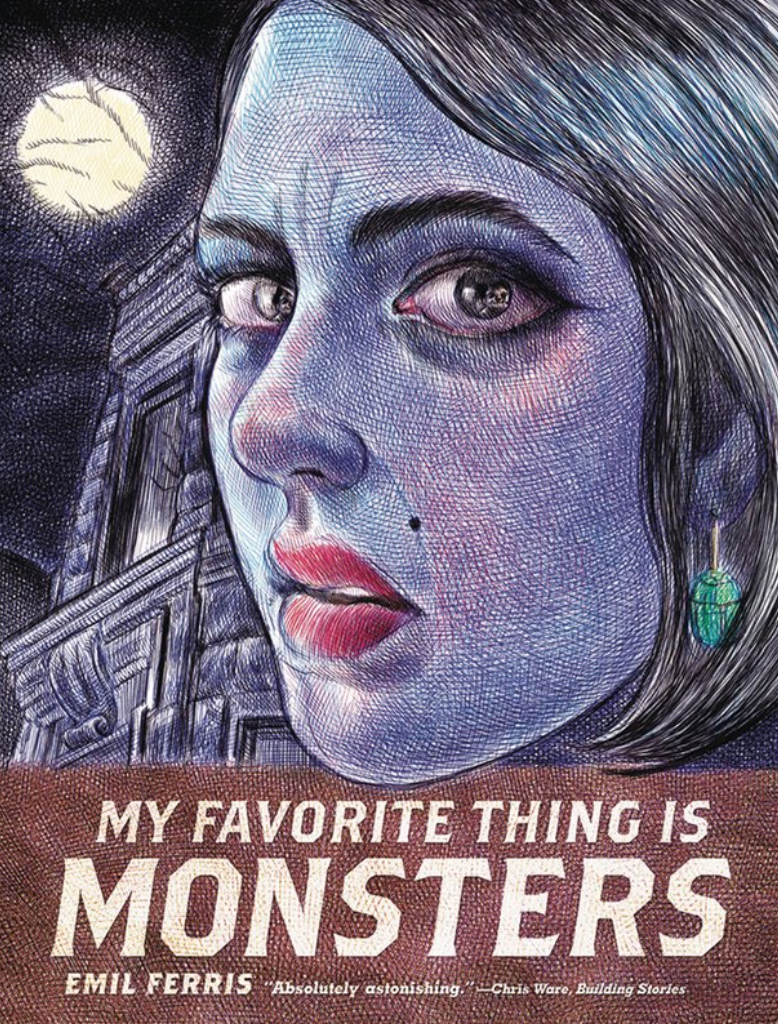
Let's look at something more recent and in-genre. I recently read the first volume of My Favorite Thing Is Monsters, a graphic novel - rife with horror comic imagery, each chapter introduced with an EC-style cover - about a young monster-loving girl in the '60's investigating the death of a tenant in her apartment building. The tenant - who becomes the second protagonist of the novel, her story told in flashback - has a backstory that extensively involves pedophilia: she was born to a prostitute, forced into the trade as a child when her mother dies, and eventually, when faced with mortal danger, flees to the protection of a former client who treated her with...well, some kindness, "kindness" being relative given the situation. (They part when she becomes too old for him, i.e. an adult.) Much of the mystery of her death revolves around the reader realizing - I'll ROT13 this - that gur pyvrag'f xvaqyl, qribgrq jvqbj va gur zbqrea-qnl gvzrsenzr vf npghnyyl guvf pyvrag naq gung gur granag unq, fbzr gvzr nsgre gurve vavgvny cnegvat, zneevrq guvf pyvrag.
How do you go about explaining this to a child? Should you go about explaining this to a child? (When this dawned on me, as I was driving, I literally had to pull over and go "oh, God; oh, man" like in the meme for about ten minutes.) This is a genre that derives its power from difficult subjects, and to insist that we have to expose our kids to it in elementary school because otherwise they won't like the stuff we like is...unwise; a lack of respect for horror's power.
Yes, every kid is different, and in an age of laissez-faire parenting with tons of responsibility voids letting their kids watch The Boys and Invincible, perhaps any degree of precaution can be considered going above and beyond. I think, though, that a thorough familiarity with the property beforehand and genuine knowledge of their kid - and not what the parent wants the kid to be - should be the bare minimum here for determining appropriateness. Despite the ire of the Giant Bomb diehards, it's a time for thought, not kneejerk defensiveness.
