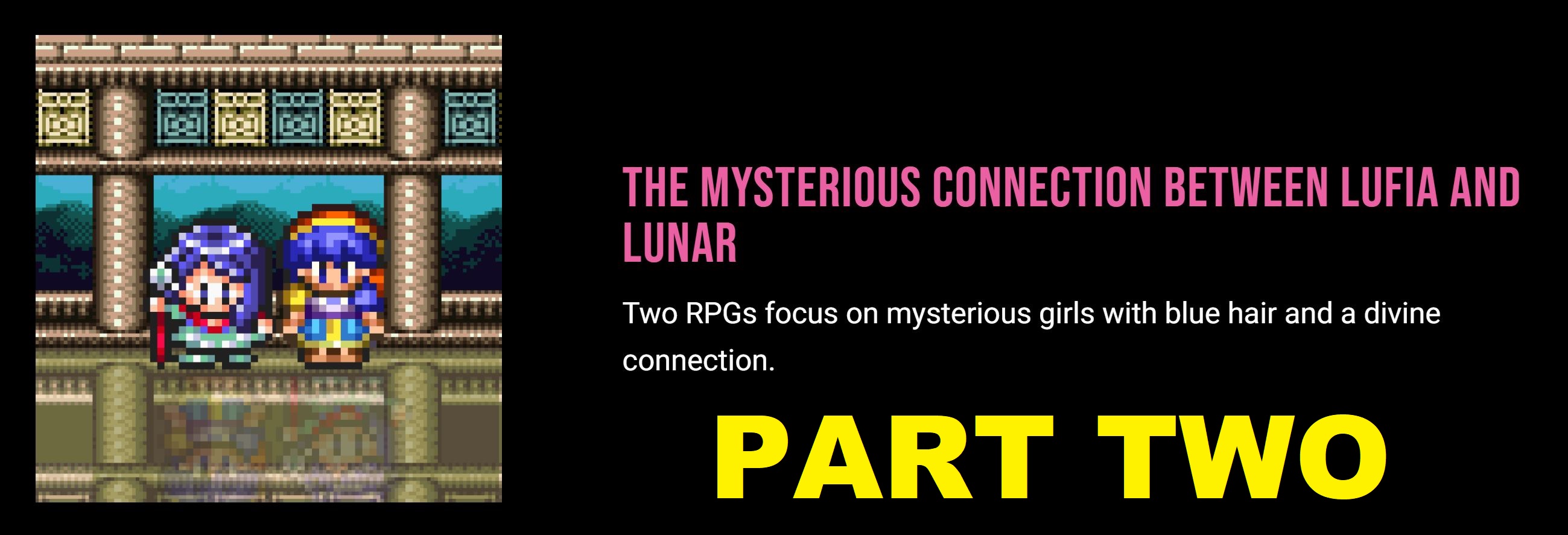
Uh, Part Two of my response. Not of the article! Though the article may receive a Part Two someday.
Most assuredly with better font work than my MS Paint image edit.
My apologies for the lateness! My attentions were pulled elsewhere, like to Michael Myers bike flips - and my, the original article has even scrolled off the front page in the meantime. To refresh: the author of Thrilling Tales of Old Video Games noted some parallels between the heroines of Lunar: The Silver Star and Lufia and the Fortress of Doom and speculated, as is the manner of the site, that they were references to an as-of-yet-unidentified predecessor. I mentioned that this was likely the megahit Ys and pointed out the ever-popular and universally-beloved article where I detail Lunar's considerable debt to Ys Book I & II but cautioned that I felt that neither game could be described as a ripoff, as the two titles take their common plot elements in very different directions. I promised to explore this at length in an upcoming article. That article is now.
Spoilers for Lufia and the Fortress of Doom and Lunar: The Silver Star (and all other Silver Star variants) immediately below the cut.
Despite them having similar twists - the red-haired hero's blue-haired girlfriend of mysteriously-unknown parentage is the reincarnation of a long-lost goddess; she is kidnapped by the villain and joins him in a brainwashed state for the climactic battle - there's a crucial difference that makes the stories, at heart, not very similar. That is: while Luna was once her world's adored mother goddess, Lufia was once "Erim, Sinistral of Death" - as you can gather, an evil being, one of the four malevolent, rampaging gods whose resurrection 100 years after a defeat by the hero's ancestor is threatening the planet. This massively reveals that they're actually about two different things.
Lunar: The Silver Star, as I detail here, is about its hero becoming a man, and what "becoming a man" means in creator Kei Shigema's eyes. To summarize, Shigema does not believe a boy becomes a man until he dedicates himself to the protection of a chosen woman, and Luna being an incarnation of her planet's object of worship, holy and placed on a pedestal and the pinnacle of purity and "femininity," is representative of that. The villain is, in various ways, presented as a bad-boy rival for the heroine's affections, and her later reappearance as his brainwashed moll, a "fallen" woman in outrageously sexualized clothing, represents what happens when you don't take care of your girl - she'll run off with bad company and become a brazen hussy. (Lunar, particularly in its earliest incarnations, is not known for its progressive gender politics.)
Lufia's "true identity," though, is that of an evil being, an object of fear, a warlike god of power and aggression - of death, the opposite of creation. She is something to be destroyed. This changes the entire dynamic behind the revelation and its implications. The Lunar revelation is a confirmation - yes, you should have been worshipping and treasuring your girlfriend all along; she truly is your moon and stars, as you've realized over your journey and through having her taken away. With Lufia, the revelation is a contradiction to her true, sweet nature, not a confirmation.
It's also a huge goddamn problem - the major source of tension in the narrative, of "what do we do now?". It's a big wrench in the hero's plans to save the world from the impending threat, not, as in Lunar, an intensification in the need to carry out those plans.
This all results in a big difference in how the plots progress and how the games treat their female leads, as well as the tone of events and, for that matter, the games themselves.
In Lunar, as stated, the realization that Luna is The One - your real reason for being, and not your quest to be a Dragonmaster - is the culmination of the game. The game is leading up to the hero accepting the responsibility of a relationship (albeit a heavily-idealized one), and its outlook emphasizes a young, naive, "just getting the hang of the way the world works" perspective, particularly at the start. As a result, in the early stages, Luna is a well-meaning but overbearing and annoying worrywart tag-along on your great big coming-of-age adventure - her attentions are an aggravation, seen as a bit of a drag instead of desired and wanted. Even in the later Silver Star Story revisions, which keep Luna in the party longer to create more of a connection between Alex and her instead of having her leave early because Her Place Is at Home, the relationship is still somewhat tentative early on, with her big added showstopping song being about how she doesn't understand what she's feeling.
In Lufia, since the relationship is threatened, not confirmed, by the big twist, said relationship has to be established earlier on. In the Silver Star Story remake onward, for example, there's a scene where Luna hesitates to join Alex on his quest but ultimately jumps aboard the ship he's boarded, entranced, taking a leap of faith, one parlayed in short order into her famous Disney Princess song. It's all hopeful and fairytale, befitting Lunar's bright-eyed outlook. Lufia also has a scene where the heroine decides to join the hero on the quest, but - while it is still romantic and sweet - there's a lot more talking, negotiating, and give-and-take: more of dealing with realities and discussing the issue like adults. Lufia acknowledges that her priorities were misplaced in a previous argument where the hero had to deal with a crisis situation. The hero notes that she'd be in danger even if he made his best efforts, and though she counters with an expression of faith in his and her own abilities, she still acknowledges it. There's a good deal of "buffering" conversation - bringing up past incidents in their shared history, dancing around difficult questions - that would naturally occur between two people who know each other well and for a long time, that helps make the relationship seem believable and lived-in. (Lufia's writing was hailed at the time for its naturalism in some scenes.) Lufia and the hero talk more honestly and tackle problems as a team, like an older couple would. Though both games do deal with young love and both sets of leads are around the same age, Lufia's approach makes it relationship seem more developed and further-progressed, and the interaction between the couple takes on a different flavor.
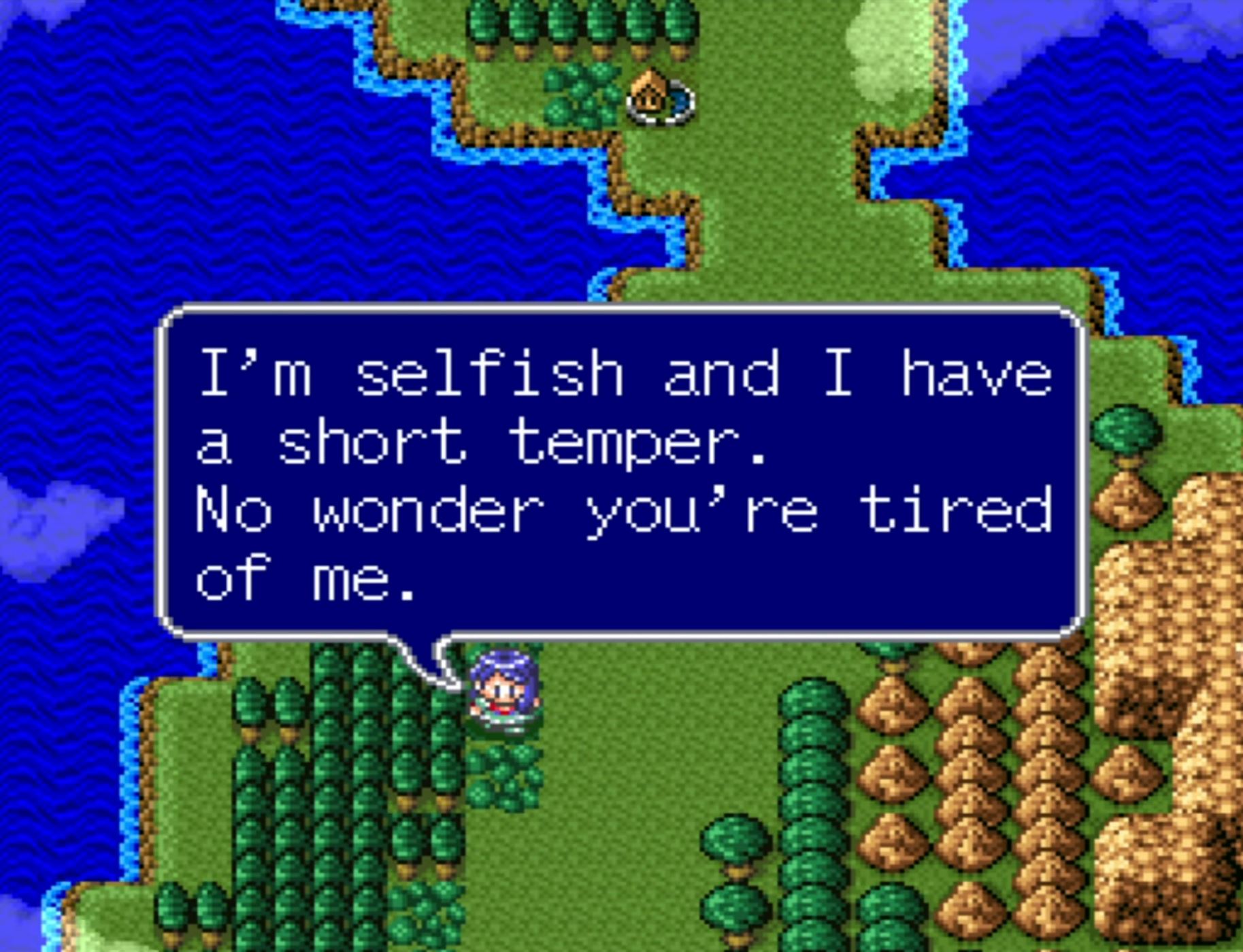
Incidentally, all the shots of Lufia are taken from this LP by Look Back Gaming.
Thanks for the chapter markers; they were very helpful.
This also results in a huge difference in how the heroine is treated by the narrative. Luna is, basically, a damsel. She is put on a pedestal by the narrative, as an ideal; something to be attained. Even in the remakes, she's gone for much of the game and doesn't have as much interaction with the plot or world as the other major characters. Lufia has more agency. She's allowed to take the lead in conversations - reassuring rescuees, asking for vital quest information, etc. There's more of a sense that she and the hero are working as a team. She's less protected than Luna - which is significant, as events eventually make her very unprotected indeed.
The darker nature of Lufia's revelation also endangers the relationship in more vital ways than Luna's brainwashing. There's a crucial scene, after the heroes learn the bad news from some instructive statuary and regroup at a village inn, where our viewpoint is severed from the hero's and we follow Lufia as she eavesdrops on a discussion between the other party members, trying to come to terms with this revelation and figure out what to do. They're not being malicious or underhanded (they're discussing this apart from Lufia because they don't want to alarm her, not because they're planning on stabbing her in her sleep), but this is a difficult situation, and they're at a loss for options. The difficult question comes up as to whether the hero can slay his beloved if it comes to that, and, gobsmacked, he can't say he can - but he can't rule it out, either, and is clearly pondering the potential eventuality. Lufia then scurries back to her room at the inn where they're staying and pretends to have been asleep. She doesn't let on that she overheard the conversation - nor does the hero let on that he was considering killing her. Though it's not outwardly noted between them, there's a schism between the hero and heroine at that point - they're keeping things from each other, for their own survival; though they're uneasily cooperating for now (and do want, still, to believe in each other), they now have separate agendas that may be incompatible and may threaten each other's lives. There's a tension between the hero and heroine; they no longer trust each other.
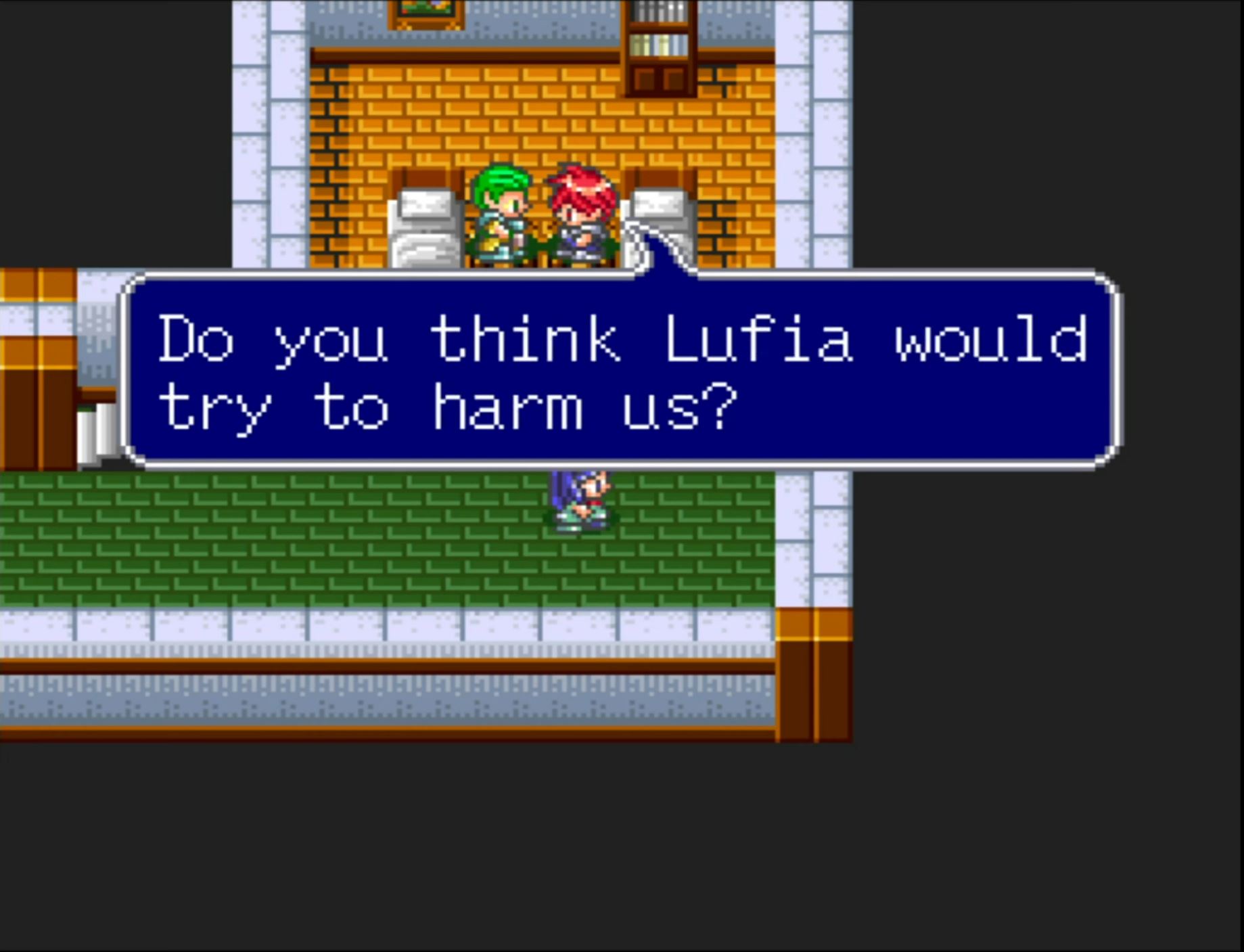
This sort of tension would be unthinkable in Lunar, where faith and unbridled optimism are the series's bread & butter. I can't see Lunar ever giving Luna a scene like this - where we're encouraged to identify with the heroine's plight and mindset in a way that's counter to the hero's priorities; where we and the heroine are allowed to doubt and fear the hero like this, even if his (potential) actions are understandable. If this were Lunar, Luna and Alex would not be allowed to express anything but undying faith in each other and that they (or, rather, just Alex) would find a way to end this without tragedy. Again, Lunar is consciously not going for realism - it's very fairytale, deliberately. But this scene underlines that despite commonalities in their starting points, Lufia and Lunar are very different stories.
(The developments in Lufia continue to be more complex, by the way. When her fellow Sinistrals next pop up, Lufia goes along with them partially willingly, albeit after much confusion and hesitation, because she's afraid the party members might kill her. We also have the added complication, though, that we're not dealing with a brainwashing but a surfacing of a past life / foundational consciousness within the heroine - after arriving in the Sinistrals' lair, she doesn't declaim her worries about the hero, but she is, in a moment of...body horror? consciousness horror?, dazed and disoriented - she's still Lufia, but she doesn't understand where she ends and Erim begins. It's a more complicated scenario than Luna's kidnapping & brainwashing, and unlike in Lunar, we're not given the safety of an uncomplicated break between the heroine and her threatening other persona.)
The difference between Silver Star and Fortress of Doom remains in their endings. Silver Star's ending is pure triumph and wholesale validation for Alex, a warm benediction in literal light - his maiden attained, manliness validated, and knightly panoply complete. There's even an extended playable sequence in later versions where he can walk around and have NPCs hail him as the bestest ever. As I've kvetched previously, becoming an adult in Silver Star means getting everything you want and achieving everything you attempt. The ending of Lufia, however, is bittersweet: the other Sinistrals are defeated, but Lufia recognizes she indeed cannot survive if the danger is to be truly eradicated. She urges the hero to strike her down, but when he cannot bear to do it, she herself prompts the special Plot Sword into administering a fatal blow. Her last words, meant to comfort her love, are perhaps the game's most memorable: "I was happier in my brief time as Lufia than in the eternity I spent as Erim." She then falls to her death. The hero survives but merely staggers away from the site of his victory wordlessly, his triumph hollow. The other heroes start to go after him but realize there is nothing they can do to say or help.
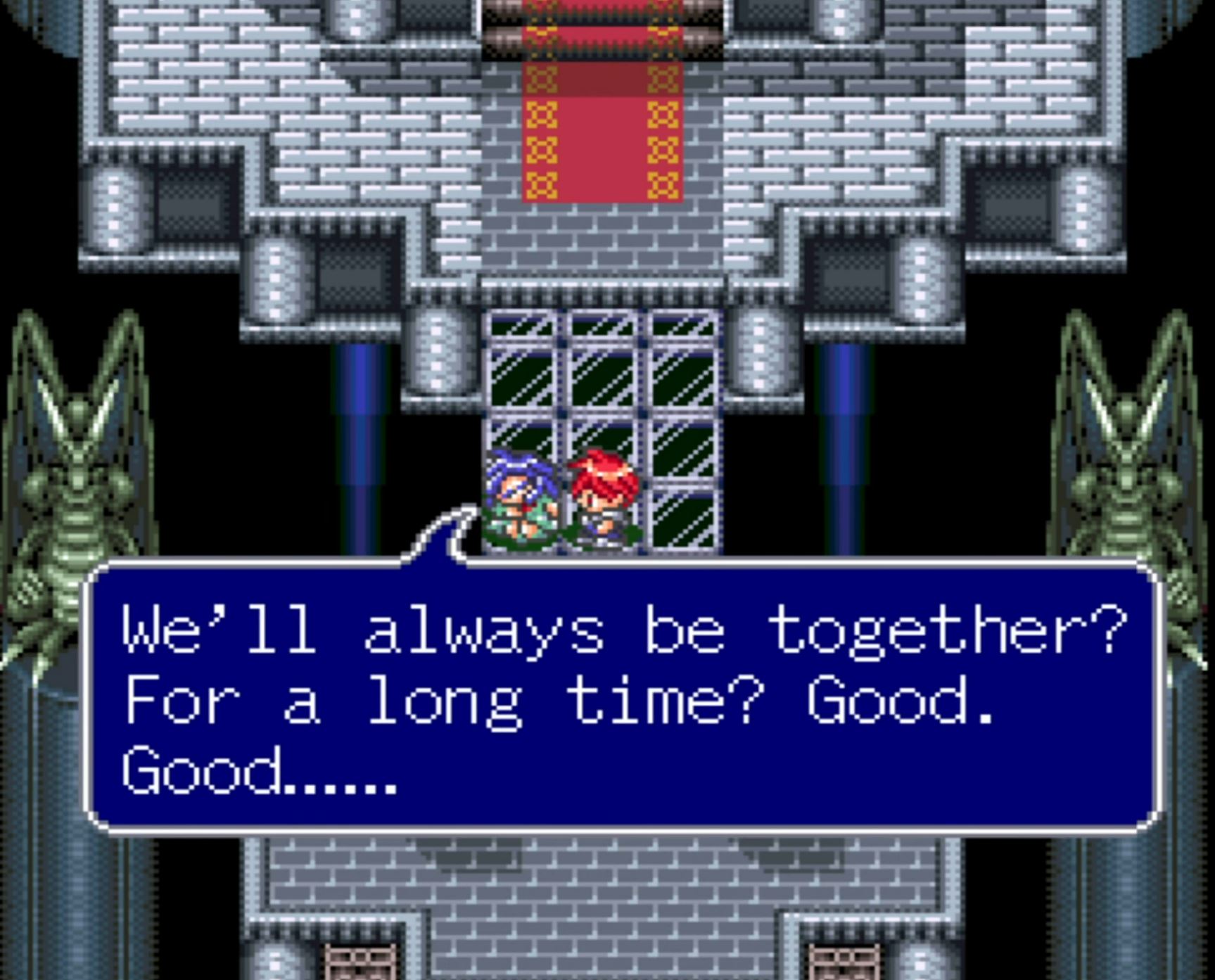
Another sad bit unthinkable in mainstream Lunar: a dying Lufia asks for reassurance from the hero that they will be together for a long time, which the panicked hero gives, even though they both know it's a lie.
The hero continues his wanderings, traveling the globe aimlessly, until one year later, when he encounters...Lufia, her memory gone, and her consciousness somehow severed from Erim's. Her caretaker takes the hero aside and explains that, even if Lufia knew him before her memory loss, she won't remember him at all now - any past relationship between them is effectively gone, as Lufia no longer has any of their shared memories. He pauses, then says, as the sentimental soundtrack finally explodes into joy: "That's OK...we'll make new memories!" It's ultimately a happy ending, but not like Silver Star's; it's accepting of some losses, and understanding that you don't have to win-win-win - you can still find joy regardless.
So despite a commonality, the two games take that plot point in very different direction, and it in turn shapes the games into very different things in many aspects. One could say, in fact, that the franchises' achievements lie in how they differ. As I mentioned, one of the things Lunar fans typically love most about the series is that sunny optimism and its wide-eyed innocence, where the heroines are doe-eyed and the heroes are almighty and love conquers all. In contrast, Lufia fans enjoy love stories where the love ultimately endures despite some very real tests, despite the heroes in some ways not winning. (This isn't present solely in Fortress of Doom; most playing Lufia II will know from the first game that the hero and heroine - whom we see fall in love, marry, and have a child over the course of the sequel - will both die in the final battle, even though they have an infant son.)
Now: I'd like to note something about the research done at the site I linked, which is very heavily along the lines that works can be explained primarily as references to other works. I'd like to say a few words about the limitations of that approach.
First, as illustrated above, I think the author is overlooking the importance of archetypes and fundamental psychology when it comes to storytelling. Yes, I think it's quite possible that Lufia took design elements for its redheaded hero and blue-haired heroine from the extraordinarily-popular Ys, and as detailed, I think it's all but certain Lunar did. It could also be, though, that hair color is one of the easiest ways to differentiate big-headed RPG sprites; red is a color that pops visually and is identified as "active," which pairs well with a sword-slashy hero; the heroine, often the second most-important character in the plot and envisioned as the yin to the hero's yang, is frequently conceived as a visual counterpoint to the hero, and cool blue, connoting peace and tranquility, acts as an offset to warm red, as teal & orange movie poster memes have taught us. Yes, a character in an enchanted sleep in a crystal or glass coffin could be a reference to a plot point in Saint Seiya...or it could be a reference to Snow White, perhaps the most prominent cultural touchpoint for that visual...or it could be an effective way to communicate someone good and pure, prized and precious, being kept away from the filth of the everyday world, in a place of honor and veneration that is nonetheless sterile - kept safe and inviolate, but kept away from warmth and love, a metaphor for a number of tragedies, psychological and otherwise. (If the visual is framed from the perspective of someone who remembered and loved them in life, it's likely a metaphor for how this effectively-dead loved one remains an ever-vivid presence in their psyche, a symbol of everything good that, to them, is no longer part of this fallen world, from which they cannot move on - another type of tragedy.) Visual and plot point metaphors gain popularity in the first place because they tap into the primal psyche in some way - prove effective symbols for internal struggles and ideals. It's the Hero with a Thousand Faces idea.
Let's look at another big parallel between Lufia and Lunar on which the article doesn't touch that much, and that can't be traced to Ys: the four heroes subplot, where a venerated quarter of heroes who combatted and vanquished the last major threat to the world and serve, in part or whole, as supporting characters in the current narrative. As with the heroine, the four heroes group means different things to each story because of the differences in the stories being told. Lunar's story (in addition to the themes I've mentioned previously) is about coming of age and taking on the responsibilities that your parental figures once shouldered, and the Four Heroes in Lunar serve as the examples to which the current party has to live up and surpass. The heroes are gradually incapacitated or unable to help as the narrative progresses, placing more and more responsibility upon the young, untested party; most of the party members are children or proteges of the Four Heroes, creating a greater personal challenge and emotional contingent to the proceedings; and one of the heroes is in time revealed as the driver of the current crisis, posing the ultimate test of the new heroes' ability to stand on their own two feet. Many of these aspects are present in some manner in Lufia, but the heroes there are treated more like leads, as the last people to fight and contain the menace we seem to be currently facing. They're shown respect, don't get me wrong, but, again, we're dealing with the element more practically than emotionally; the protag's a descendent of one of the heroes, yes, but he's more primarily a knight trying to identify and solve a threat to his kingdom and world when the existing power structures are just not functioning properly, chasing down whatever scraps of info he can to survive.
Is the Four Heroes element a callback to a common homage? I don't think so. (Final Fantasy V, say, also has it, with no blue-haired Feena-alikes in its cast.) There are elements in RPGs that pop up across titles: a sacred sword passed down through the generations with a unique ability to combat evil; a damsel-in-distress girlfriend; a collection of magical doohickies that have to be assembled to vanquish an ancient demon lord...well, I'm sure you've been on TVTropes. These elements persist because how well they satisfy something in the psyche of the target audience (primarily teenage boys, for RPGs of a certain vintage) or how effective they are in fueling gameplay. The Four Heroes are here, generally, "the standard of adult success and competence whose deeds the protagonist must duplicate to come of age and succeed in his quest and as a hero," with four being the magic number because four was the typical manageable party size in the day and large enough to have a variety of personality types but not so large that a background element gets distractingly outsized. Again, though, this commonality, though not reference-based, illustrates the differences between the stories, with Lunar's take more emotion-based and idealistic and Lufia's a bit more pragmatic. Which brings me to my second point.
That is: I think the "everything is references" approach to analysis is kind of cynical - to reduce a game, to paraphrase Thomas Harris, to a set of influences. Every creator has their influences, of course - none of us grows up in a vacuum - but I think this approach elides what new ideas a creator brings to an established premise: the old Roger Ebert idea that it's not what a story is about, but how it is about it. Take Lunar: One of the big assertions of that article I wrote - one which is overlooked by a lot of folks reading it - is that Lunar did a lot more than Ys with the plot points and aspects it swiped. Lunar rightly recognized that a former guardian turning against the powers they served could be the impetus for a compelling plot rather than an irrelevant footnote. The Blue Spire is taken from Darm Tower, with its blue-stone color scheme swiped from Solomon Shrine, but the combination of form and substance; the locale's link to a cold, iced-over world of death and its lone, emotionless resident, the driving force of the story; and its position in the narrative - as a remote, unexplored place of mystery used to initiate a young archaeologist into a that has its roots in the legends he so loves - combine to make an indelible place. What you do with your plot points matters.
The article is trying to find this common thread between Lufia and Lunar to understand them, but finding the starting point actually wouldn't help you to understand the stories at all, as the two games take their biggest point of commonality in different directions. To understand the games, you have to take them on their own terms.
(Not really ETA: Right as I go to post this, I note that Thrilling Tales of Old Video Games has added an article that asserts the panther-man character in Golden Axe III, Chronos Lait, is a reference to Beauty and the Beast because of its song "Tale as Old as Time," and "Lait" is an anagram for "tail," which is a homonym of "tale." Like in the song. After peering at the article for a while like in that one Kate Beaton comic, I think this is meant as a serious assertion...but this does bring up the possibility, despite previous evidence to the contrary, that the entire site is, bluntly, taking the piss. If it is, at least we got some discussion of Lufia and Lunar out of it here, not as if we don't have literally over thirty articles on the latter on this site already.)
(I am of the opinion that Chronos's surname is a misspelling, intentional or not, of "late," keeping up the "time" theme. This would be poor nomenclature, but remember that the devs gave him the nickname of "Evil" - Chronos "Evil" Lait/Late. The nomenclature is already far from God's grace. For more fascinating Golden Axe info that's a complete non sequitir from anything previously under discussion, please visit my review of Golden Axe III, where I sort out what I believe is the much-discussed way to get the good ending. Contains more use of the phrase "greater than or equal to four" than you or any sane person might expect.)
