
Also, "You need to know when you're an NPC."
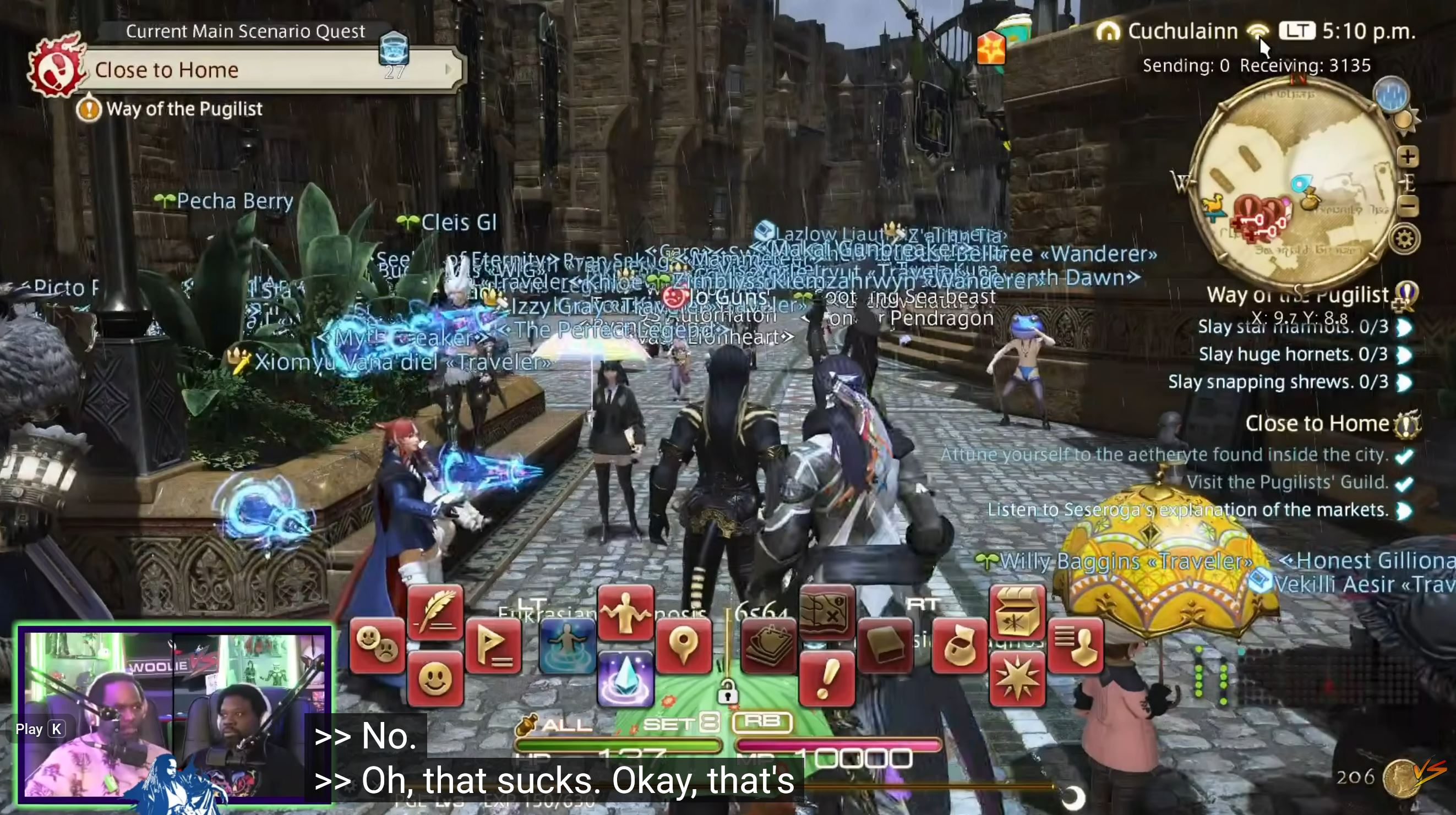
A couple months ago, FFXIV fan Pat Boivin, of Two Best Friends Play and Castle Super Beast, tried to get his cohost Woolie Madden into the game. They announced they'd be streaming his experience, which was probably a bad idea, as the starting area was flooded with "welcoming" committees, would-be mentors - people who wanted to take over his experience for him. There were also dozens of folks gathered around to unleash flashy emotes, to jump up and around Woolie so their character & guild name would be visible on the stream, etc. The crowd derailed the experience and was the primary point of discussion immediately following the video.
This brings to mind a few things I've noticed about humor in fandom circles recently that I'd like to discuss.
The first is the wisdom contained in a post on that great mass of humanity known as Reddit, about a wedding guest who wanted to wear to the ceremony a theatrical, attention-getting dress festooned with messages that were meant to be supportive of the couple but could have been construed as offensive. The wisdom of the crowd advised against wearing the dress, with the best answer, I feel, below:
"People need to understand they're basically NPCs at a wedding unless they're immediately close with the bride and groom and even then they're just background characters."
In other words: you need to understand when an event is not about you. Here, the event was supposed to be about Woolie, as he (theoretically) reacted to a well-known game beloved by the podcast fanbase. Some attention-hungry people instead made it about themselves, to the point where they stopped the actual event from proceeding. (At least initially; there have been subsequent installments, unseen by me.)
I don't think they thought they were being rude, though. I think they thought they were being genuinely funny, even when they were stopping things from happening and preventing someone they ostensibly loved from enjoying the game. Which brings us to my second point.
A lot of fandom people believe they can't be bullies because they themselves were bullied or ostracized in their youth and have internalized that they are permanently on the "victim" side of that dynamic. If anything, like the hordes besieging Woolie, they think they're cute. Cuteness typically is associated with innocuousness - non-threateningness, a lack of power. These folks genuinely believe that their behavior could never hurt anyone - they're not capable of hurting anyone! They're victims, after all!
So: Even if you think you're cute, even if you've been the victim of jerks in the past, you yourself can still be a jerk. If someone tells you to stop, stop.
My third and final point has to do with the problem of humor. Running jokes are perhaps (next to puns) fandom's favorite form of humor, with "commit to the bit" the guiding rule. (To continue the Giant Bomb theme from last time, think of all the people who respond to any mention of Jeff Gerstmann with "STILL A THREAT! STILL A THREAT! BRAWK BRAWK BRAWK".) I think the appeal here can be explained: humor usually takes a good deal of social skill - you have to hit with the right timing, consider how your audience will receive your joke, deliver your joke well, read the room and vibes before and after, etc. etc. (And you have to think of a joke besides!) Social skills can be a challenge for some fandom folks.
Running jokes, however, seem to bypass all this. All you have to do is repeat what someone else did before. It appears to be the most rock-solid, Skinneresque 1-for-1 correlation between effort and reward: Someone else said this, and people thought it was funny. If I say it, people will think I'm funny, too! You don't even have to think up an original joke! You just have to parrot. Commit to the bit, and a reliable payoff of social acceptance and positive attention is seemingly assured.
That's not correct, of course. A joke that was funny the first, second, or third time is rarely as funny the 423rd. (If it is funny that 423rd time, it's usually because the teller has given it a twist with content, timing, etc. - which requires skill.) Sometimes a joke is funny for a bit, but the humor eventually runs out, or the group or your host wants to turn their attention to something else now - like playing the headliner game on the stream. A bit of #1 still applies here: Even running jokes require a degree of social awareness for success, and you need to know when you need to put aside what you want to do, or being the center of attention, to allow the group activity to proceed.
So: Committing to the bit does not automatically make you the funniest person ever. It can be unfunny, rude, and kill a group activity dead. Unfortunately, you still have to read the room in humor, even if reading the room is difficult with all the gamertags in the way.
