(Note: I've had this post largely written for a while, but due to recent travails, I haven't been able to finish it until now. Rest assured I have not been pulling your leg and putting off various commitments to write umpteen pages on Final Fantasy. Those same travails, however, mean that I'm not able to futz with the original-rez pngs right now to make them a more-legible size. I apologize and ask you use the magnify functions on your browsers.)
A few years ago, in post titled "Do I...like Final Fantasy?", I wrote in regard to the first installment:
I regard it, somewhat abstractly at this point, as a good game. I don't think I'd ever play it again.
Well, I put the lie to those words: I played it again recently. (...Relatively recently. See below.) The main impetus was, as with The Goonies II, Jeff Gerstmann's NES ranking project, where he relegated the game to what most consider a low berth (the mid-hundreds) because he likes Dragon Warrior and doesn't like Final Fantasy and doesn't like that many people like Final Fantasy and not Dragon Warrior and Gerstmann, despite being a games journalist with an extraordinary breadth and depth of knowledge, is a very "my way or the highway" type of person (particularly nowadays, unfortunately, but that is another post).
(AN ASIDE: I think the ubiquity of and common experience with Dragon Warrior - where it was included for free with Nintendo Power subscriptions - actually torpedoed the franchise for a good, long while in the States. It's not by any means a bad game, and I remember getting enjoyment out of it, but it was published over here three years after its Japanese release date, and it is the most aggressively basic RPG, painfully linear and uncreative, both strategically and tactically. It is a game of extraordinarily limited options, where there is one single right thing to do, one single path in every scenario, and while that is fine, and even desirable, for the My First RPG it is, it can be...well, downright painful. I know, logically, that there has to be way more to the series now, but there's a part of me to this day, 35+ years later, that recoils inwardly a bit at the prospect of the idea of playing a DQ game, at what my mind will tell me will be an endless, mindless procession of rote actions: "A Slime draws near! Command?" "Thy Hit Points reduce by 3." "The Slime is running away.")
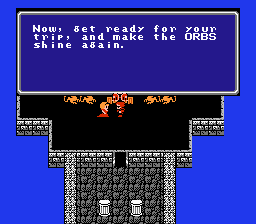
Well, I came away with my positive impression of Final Fantasy intact. Reinforced, even: replaying it today gave me an appreciation of how the game is, like, well-designed and intuitive. The entire inland sea is effectively a tutorial area. The early dungeons are actually organized smartly to teach the player how to conduct an effective search of dungeons and how important areas and items are earmarked.
I'd even defend the much-maligned mechanic where your warrior steps forward and flails at air if they were commanded at the start of the round to attack an enemy that's felled before they get a chance to act. For one, I honestly don't think it's unrealistic, so far as a video game fight goes: your little people get their marching orders before the battle is joined, and it makes sense, in the fog of war, that some soldiers are going to be left with nothing to do if you overcommit resources to a given foe. For another: I think the mechanic is actually useful. It kept me engaged. I wasn't automatically pressing "Fight." I had to think of how much damage my various party members would likely deal, and to which enemies I should dispatch them to minimize the damage I'd take and the resources I'd expend.
The game also offers a lot of variety and player choice. The composition of your party; the order in which you tackle the game world; the spells with which you equip your casters: Dragon Warrior - and I don't mean to make this a DQ vs. FF post; this particular comparison just did come to mind after the Gerstmann video - would not consider this level of player agency in its rigidity.
I also have to say: it feels good to play and finish a classic long-form game. Don't get me wrong: Dead by Daylight is an endlessly creative game, and I've had lots of fun with it, and I've enjoyed many indie gems on Steam and GoG of varying scope and ambitions. But there's something about playing through a long, foundational game like Final Fantasy that's like a meal, you know? Nutritious; like I'm returning to the roots of it all, like I'm getting back to the heart of things.
I decided in my playthrough to go only by info in my memory - no looking up spells to see what they did (even though that info was available from the start for NES gamers via the manual). I tried not to grind, but I did at a couple points stop to get up enough cash for some useful equipment. (This worked just fine; grinding actually isn't necessary.)
Also: as detailed at depressing length, I ran into a roadblock 'round about the Gurgu Volcano due to my party composition. Detailing this imbroglio took much of the wind out of my sails for detailed journaling of this playthrough - and the later stages are a bit less detailed as a result. Onward!
---The Starting Sea
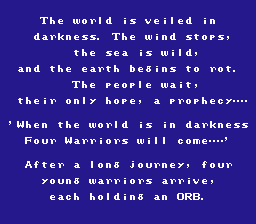
- The opening chords as the words to the intro fade in on the blue screen ("The world is veiled in darkness. The wind stops, the sea is wild, and the earth begins to rot") take me back, man. I can actually feel something primal in my brain chemistry being activated. I spent so much of my elementary school days listening to those arpeggios and watching those words fade in.
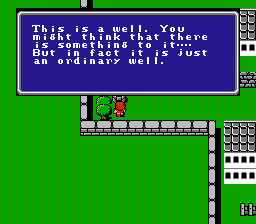
- In fact, I'll say this here: the game text is quite well-written - and for the era, it's practically Shakespeare. The NPCs are all lively and well-characterized in a single window of dialogue; the jokes are cute (the famous well bit; the "No! That is only a useless sample" is you try to "acquire" decorative swords at a blacksmith's) and even witty. Pieces meant to be tone-setting or epic - the intro; the "roll credits" as you cross the Corneria bridge - largely succeed. The text introductions of the Fiends emerging for battle, that describe them feature by horrible feature as they materialize out of billowing smoke, really do set the stakes and a sense of drama for the looming battle. It's all evocative, which is light-years beyond what you can say for most NES prose.
- Getting into gameplay, the biggest news: You do NOT, as famously asserted and subsequently held as unassailable wisdom, need 99 HEAL potions for the Marsh Cave. The manual lied! (Probably to get kids to grind, though, as mentioned, grinding is not really necessary in this game.)
- Everyone misses ALL THE TIME in combat in the early going. Party members and enemies seriously miss as often as they hit, which can make early battles drag on. This is not a long-term problem, but it can be maddening for its duration.
- Though the Black Belt is indeed an offensive powerhouse, he really is not suited for the role of backup tank in the early going. I put my Red Mage, who could equip heavier armor, on backup tank duty and relegated BB to third in line.
- The same forum that claimed White Mages were useless hyped up FAST as (in their tiresome terminology) so good. I therefore focused on getting my Fighter FASTed up ASAP in the Astos fight! Astos promptly RUBbed her. (Spoiler: FAST is not so good, and I can hazily recall only like one or two instances in the entire game where it made any sort of difference at all.)
- The Wizards and Astos were not so fearsome. They went down pretty easily, actually. I may have been overleveled, though, due to my refusal to use maps for this playthrough and consequent repeat trips to the Marsh Cave for tenuous exploration.
- In further shocking assertions: the Marsh Cave, for all its hyped-up fearsomeness, is actually an extremely smart dungeon tutorial area. Here is the first level! You can go up right, or down. Most will probably go up first, which leads to an additional floor with some treasure but that dead-ends. They'll then try right, which leads to a dead end. Down yields progress: a bunch of little isolated rooms, conveniently laid out in a grid shape. Do you want to search this floor? Search all the little rooms! (This is a kid-friendly version of complexity, an accessible way to create a "complex" space that's easy to keep track of what has and hasn't been checked.) Hey! This room has some odd-looking rock formations around its chest! Is this chest important?! Hell, yeah, it is! It has the CROWN! Ah, but there are still more rooms to check on the bottom of the screen! Hey, some of THEIR chests also have rock formations! Wait, do their chests have monsters guarding them like the CROWN did, too? Sure do! You're taught the basics of how Final Fantasy constructs its dungeons, how to navigate and search them, and how to tell which chests likely have valuable items - and attendant monsters for which you should prepare before approaching.
The Earth Cave
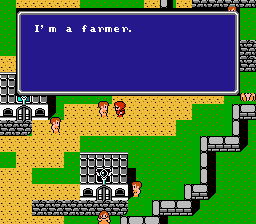
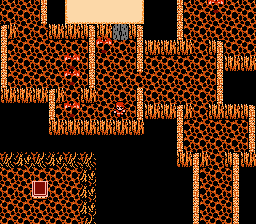
- The tutorial continues. The second dungeon is a star with six spokes: the first two from the left form a short loop, the next is a dead end, two lead before long to treasure, and one leads fairly immediately to the stairs to the next level. Granted, the loop has a mean trick in a section where strong enemies will attack you with every step (the "Hall of Giants," if you've read the walkthrough in the manual), but there's a clear desire to introduce complexity in dungeon design gradually, in a way that eases newbies into this genre.
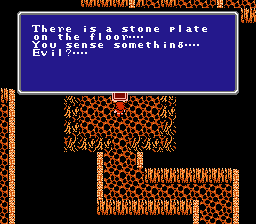
Another instance of gradual difficulty increases: Melmond, the town near the Earth Cave, has no item shop (presumably due to vampire attacks—there's no clinic either), but it's a straight shot east to Coneria, the starting town, from the town's port. They will make things harder for you, but help and mitigations are made readily available. - Swings & Roundabouts: A moment of pure triumph as my Black Mage felled the fearsome Vampire with a single shot of Fire 3 (more effective than a bureau!) was immediately offset when, on my way to check out the Plate what needed the ROD in back, my Fighter instantly got petrified by a Cockatrice, and I'd neglected to buy any Soft potions. Man, was that a tense march up three levels of dungeon and back to town. (I'd picked up WARP, but my Black Mage used my his one shot of Level 5 magic in FIR3ing the Vampire.)
- (Incidentally, in researching that reference above in a futile attempt to provide a link, I've discovered that's it's nearly impossible to cite a specific 8-Bit Theater comic, as the archive links comics only by date and includes no titles or content labels. The associated wiki's no help. Surely this must impact the relevance of the comics, since it's tough to show a good bit to folks who aren't familiar with 8-Bit Theater? Are all our FF1 LOLs, such as they are, taken up by Strangers of Paradise nowadays?)
- The game automatically rearranging your party to put poisoned characters in back gets utterly frustrating at this point, where you're running up against large groups of poisonous enemies and coming away with one or two characters poisoned per encounter. The cost of PUREs is negligible by this point compared to the time investment of rearranging your party members after every fight.
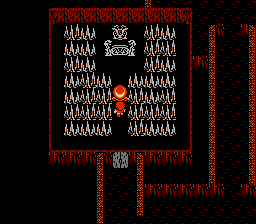
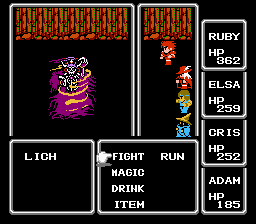
- Written in retrospect: I actually forget exactly how the Lich fight went, but it certainly wasn't hard. I think it actually may have been another instance of FIR3 -> dead (or dead again from undead, or redead, or whatever). The Black Mage is largely dead weight at this stage with his piddling 1DMG attacks, but his very situational uses are very effective. (This will not hold all game; the balance of power gradually shifts from magic to physical attacks.)
The Gurgu Volcano Debacle
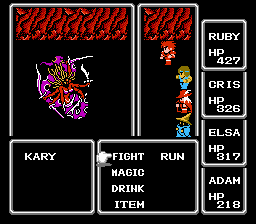
I'm going to break out of bullet points for this section, as it's basically one long, continuous narrative of a single problem.
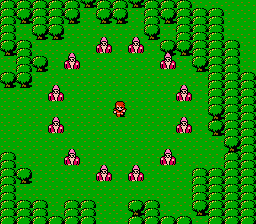
First, though, a preliminary problem: My memory actually failed me as to where you were supposed to go after beating Lich. I knew that you had to get the canoe to reach the volcano for Kary, and I recalled one of the sages gave it to you, but I misremembered Sarda as being the source of the canoe, not Lukahn in the town of Crescent Lake. It took me a good hour-plus to find my next destination, and I incurred an additional delay by finding Crescent Lake but falling for the bit where they put the sages off to the side of the town proper at the end of this winding trail in the surrounding greenery you can easily overlook. That led to more useless faffing about the map. (Honestly, with all the people talking about Dr. Unne and other matters that are chapters away at this point, one person mentioning that Lukahn's in Crescent Lake wouldn't have gone amiss.)
It was at this point in the game that the limitations of my party became evident. The Talking Time / old 1up forums once had this poster who insisted the game was much easier if, instead of going to the Gurgu Volcano to take out Kary at this point, you just went around the map and collected treasure, eventually taking out the Fiends of Wind and Water and saving Kary for last. Conventional wisdom at the forums also dictated that White Mages were useless, easily replaced by potions and another party member with higher attack power.
I always wanted to give this approach a try, and I thought this a perfect opportunity. I also took the chance to try something slightly different from the old dependable beginners'-choice Fighter-Black Belt-White Mage-Black Mage party I always used; the Thief, with no bonus but extra agility, didn't have much appeal for me, but I thought it'd be interesting to substitute a Red Mage for my White.
One thing I overlooked, however: The people making all these grandiose recommendations are likely savescumming. I am not: I'm making a backup savestate every time I save at an inn or whatnot, but I'm not saving when or where I can't by in-game rules.
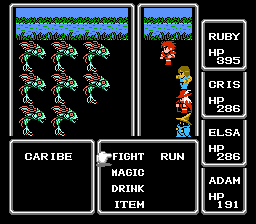
This hadn't posed a problem previously, but the two major dungeons in the Fire Fiend portion of the game, the Gurgu Volcano and the Ice Cave (which leads, eventually, to the airship and the advised sequence-breaking), are each accessed by paddling via canoe from Crescent Lake base camp down little mazes of riverways infested with encounters with Caribes: these fish/shrimp enemies that seem always to go first and always come in plagues of six or so. Final Fantasy has had a problem with tedious encounters previously, but combined with the waterway mazes and the amount of doubling back you have to do, it makes just getting to either dungeon a huge pain-in-the-ass undertaking.
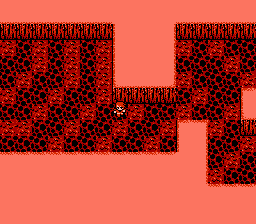
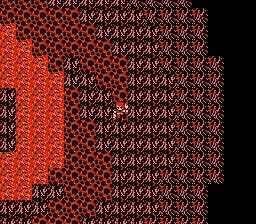
The dungeons are also a huge step up in the amount of resources you'll need and risk you undertake. The Gurgu Volcano presents you with several floors of mazes covered with damage tiles; a couple floors have treasure chests, but for the most part, your challenge here is to find your way to the Fiend before the damage tiles, combined with the harder-hitting monsters in these parts, exhaust your healing resources. Unlike previous dungeons, it's largely not an issue of making numerous expeditions to clear out the cave of the treasure chests; it's finding the shortest route to the boss through trial and error so you eventually have a run where you've got enough resources to take her on.
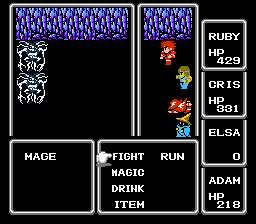
The Ice Cave, meanwhile, throws a number of enemies at you with one-hit kills. The enemies are sufficiently strong here that attempting a run with a couple party members down is not viable.
Both dungeons also have enemies - the Red Gargoyles in Gurgu and the Frost Dragons in the Ice Cave - with hard-hitting party-wide elemental spells that can wipe a fully-healed party in a single turn without appropriate defenses. (Two Fire spells from the Red Gargoyles can lay your party flat; the Goyles travel in packs of up to six.) I'd recalled Gurgu being a beast but hadn't wanted to waste my Red Mage's limited spell space on anti-elemental defense spells with very limited range and uses; given the danger, I relented, only to learn from bitter experience that the Red Mage takes so long to cast these that the enemies will have more than enough opportunity to fling lethal spells your way before the protections are even up.
OK, so: a party with a White Mage will have more healing for Gurgu and the LIFE spell for the Ice Cave and its instakills. I had neither; Red Mages cannot cast LIFE, and their CURE output is, frankly, kind of pathetic - at this point, CURE3 reliably gave me less than a couple Potions' worth of HP recovery. Given the very limited number of casts mages have in FF1, I was forced to lean on Potions for healing as heavily as if I had no White Magic whatsoever.
Furthermore, if a party member was downed, be it via instakills or overwhelming elemental damage, not only would further progress in the given run be scuttled, but I'd be forced to trek out of the dungeon and tediously paddle my way back through the Caribe gauntlet to the resurrection Clinic in town - sometimes risky, and always, always mind-numbing busywork. (Even successful runs were punished with a lengthy trip back to town: you'll need to restock your Potions to survive the next run, after all.)
In other words, White Mages are not, contrary to Talking Time's assertions, useless. They are nigh-indispensable here to making progress within a glacial epoch. A savescummer would just put up a savestate every floor, say, and reload after an unlucky battle, but I was playing by the game's original rules and didn't allow myself the luxury of cheating. White Mages did, in fact, have a very useful role. It looked like I was stuck.
The key to getting unstuck, I thought, was to go through the Ice Cave and get the Floater so I could get the Airship and get my class change. Surely that would solve matters. The gauntlet of instakill enemies, though, proved an impossible barrier, and the time-consuming logistics of refueling at Crescent Lake limited reattempts.
I'd like to say I found a Key to Everything to resolve this debacle through cunning and smarts, but I'm afraid my solution was just luck and extremely conservative, piecemeal exploration in Gurgu. I cleared out the early treasure level in Gurgu in a few runs, went for Kary on my first, long kamikaze run through the damage-tile floors, by which time I had next to no healing left (the enemies can really be killers). I then took a couple runs to retrieve the treasure from the lowest floors (with each run eating up all my Potions and subsequently requiring another trip back to Camp Crescent Lake). That gave me a couple levels with which to take the Ice Cave with more confidence, but I didn't fuck around excessively with the Frost Dragon-infested treasure levels - I just found the path to the Floater and got out - and I happened to have a lucky run where only one party member got iced by instakills.
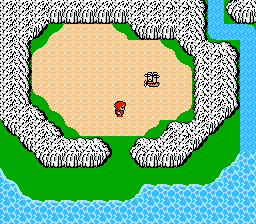
Still: this is a very daunting, very tedious portion of the game, particularly without a White Mage. I don't think Gurgu on its own is so daunting a challenge that it needs to be saved for endgame, as per Talking Time wisdom. But it's an utterly massive sink of time and resources, and the game presents it alongside an alternative path that's also a massive sink of time and resources, and traveling back and forth between both dungeons to find this out is...well, say it with me.
Also, allow me to return to bullet points for one issue:
- Fuck this game for playing the "friendly cave" music in the Ice Cave.
Thank you.
(I had actually completely forgotten about the existence of the Ice Cave before spotting the entrance on the map, starting poking around, and thought the residents were just hiding themselves away deep, deep inside. "Oh, man, monsters? Well, I don't remember a big dungeon in this area. Maybe I just need to go down a level? Man, this corridor is long! ...Oh, this is a whole thing.")
I actually think the dilemma the game poses to player using neither White Mages or savestates is an intriguing one. The game has genuine thought and planning behind most of its design decisions, even its bastardly ones. But this section of the game is a pain and a half (and trying to solve it by delaying Gurgu won't help, because the only other path, the Ice Cave, has its own problems), to the point where I'd recommend the tried-and-true classic beginner's party based on it alone. It won't solve all your woes, but you'll sure as heck have an easier time than I did. Support your local White Mage!
One victory: my Black Belt one-shotted the fearsome EYE guarding the FLOATER and its XXXX spell.
Also, at this juncture, the party members' various competencies, and baseline pure-ass competency, began to shift.
Fighter: A+. They tank literally almost every hit for 1 damage, and they're the biggest offensive engine up until this point in the game. 4 Fighters must be the Silent Hill raygun of this game.
Black Belt: Also great. Reliable damage output once you get past the early "do I hit more with Nunchakus or not?" inflection point, and at this stage, with the number of hits he hands, he actually begins to eclipse Fighter. Only drawback: he takes actual damage.
Red Mage: For the first third of the game, my Red Mage was a backup Fighter, doing just a bit less damage in exchange for magic abilities. Here, her damage drops like a brick - she'd been a second Fighter until this stretch, and now she was doing half his damage or less. Her magic wasn't compensating: it doesn't heal enough to be a major source of healing - but, meager as it is, you'd rather put the charges toward HP recovery than offensive spells that don't do much more than a basic attack. She also stops getting high-level armor, losing her defensive edge as well as her offensive. This feels like an intentional nerf than a gradual diminishment of returns on a minmaxxing character, but either way, she never got back her previous usefulness - instead of a jack of all trades, the emphasis was on "master of none."
Black Mage: Oh, man, the Black Mage. Oh, MAN. He near-always goes first, but he can't do anything - can't run from enemies, can't hit physically for squat. An occasional housecleaning with FIR3 etc. to get out of an aggravating/potentially dangerous random battle is useful, but not enough to offset the character's being utter dead meat outside of boss battles at this pre-Zeus Gauntlet stage.
Speaking of Which, the Class Change. Also, Getting an Airship
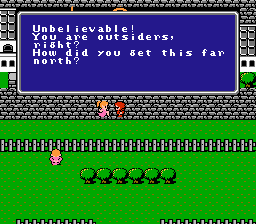
Thus begins the Great Remembering. Everything from this point on is largely recalled in retrospect rather than being chronicled as the game was ongoing.
First, let me say: it is really liberating, after spending hours and hours wending your way through little capillaries of stone and bumper-to-bumper Caribe traffic, to get out in the goddamn airship and just fly. (Intentional, I imagine, as the other environments in the previous stage of the game are suffocating: the red depths of Gurgu; Crescent Lake, hemmed in with forest; even the Ryukahn Desert, where the ship is buried, is this little thing near-wholly encircled by rock. I'm again impressed by the game's design, not just in its mechanics (despite the lapses above) but in its aesthetics.)
Every other location in the world is basically accessible to you once you get the airship, though some are a bigger hike from the parking lot than others. No longer are you confined to your little tutorial inland sea - you have full freedom of movement, and no real direction as to where to go next. Get out there. Explore. The game trusts you to find your own objectives.
Most players are going to go for the towns of Onrac and Gaia, both of which offer ample airship parking. Gaia has a cool location high in the mountains and attractive equipment upgrades, but Onrac has a more arresting feature: a determination to use the ENTIRE sprite sheet:
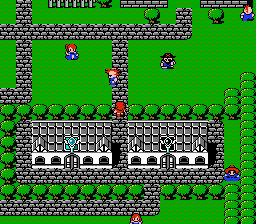
Dancers! Coneria palace guards! Mohawk guys! Witches! Dr. Unnes!
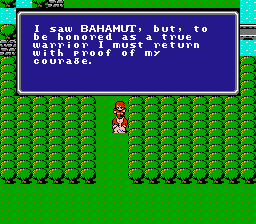
Even a walking, talking dragon, which is a double take if you haven't been to the island chain where the walking, talking dragons live first.
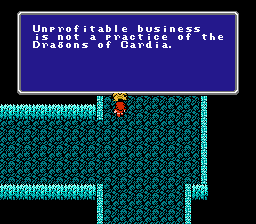
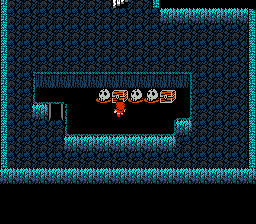
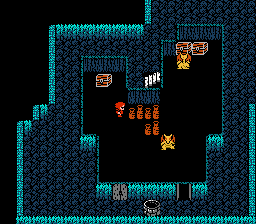
The walking, talking dragons are apparently avid capitalists. They are also into decorating with pottery and human skulls, which might explain how their trading with the humans tapered off.
Speaking of the walking, talking dragons: The next objective should be to get a class change. This is a good time to talk about leveling up. You can, actually, reach the Castle of Ordeals before getting the airship by docking the sailing ship at a distant stream mouth and hoofing it, but it's not advised, as the castle has hordes of enemies with "time to get ProRings, motherfucker" instakills. You also can't do anything with the TAIL you get until you have the Airship, as Bahamut's island chain has no human harbors.
Once I was properly ProRinged, the biggest obstacle was navigating the castle, which I had forgotten was a teleport maze - only mildly irritating. After previous frustrations, I was het for the Red Wizard to get LIFE but unsure if she would. But she did, and light erupted from the heavens and bluebirds sang, and all was right with the world, at least until the arrival of the next Caribe infestation.
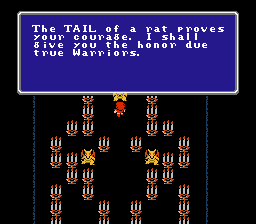
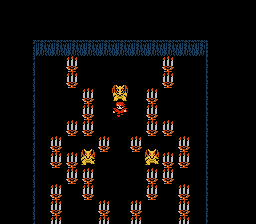
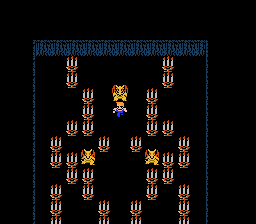
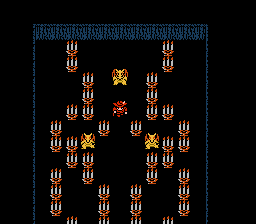
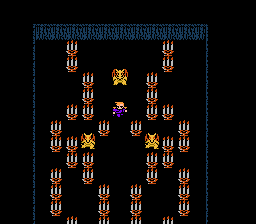
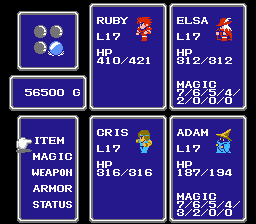
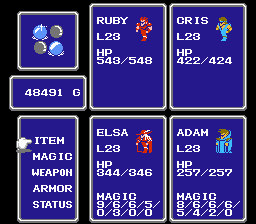
I remembered broad-chested Fighter; the Red Wizard - which I'd never had before, of course - is expected; I forgot about the Master's muscle shirt and edgy hairdo. Also forgotten: that the overworld sprite for the Black Wizard looks like Baigan. Like, I remembered the FF1 B.Wiz is "unmasked" instead of shrouded by his hat, and that in his battle sprite, he keeps the gold epaulets, but the battle sprite has a roomy blue wizard robe, whereas the overworld sprite sports a trim, form-fitting military uniform with a dashing asymmetrical waist cape. It's disconcerting.
The Sea Shrine
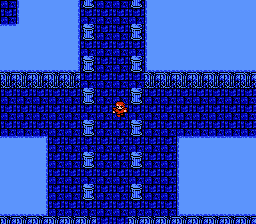
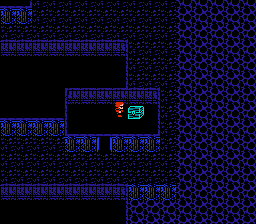
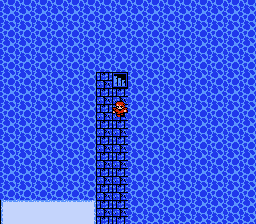
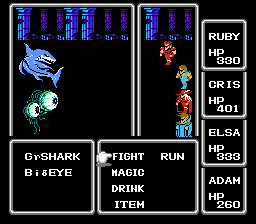
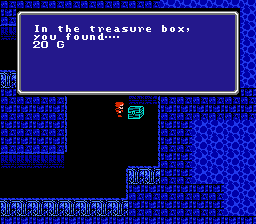
There's not much to this section. I like the Sea Shrine. I like the numerous pretty, deep shades of blue used to communicate your journey into the depths, and the ancient temple aesthetic. I like the pretty, alliterative name. I like the presence of the mermaids to whom you can talk, the presence of friendly NPCs in this separate, forgotten place, and the whole subplot about them fearing the odd yet thematic fate of being transformed into bubbles with the ruin of their habitat. I like that you can revisit them after the fiend's defeat ("Now, the sea will be as it was before, beautiful,") and the little touch of the mermaid wondering about her friend who vanished after seeking legs - whom you can find in Onrac, marveling at her newfound legs. (She's named "Dar[r]yl," appropriately.) The place manages to communicate a sense of danger, mystery, separateness, charm, and beauty using squat 8-bit NES graphics. It's my favorite place in the game.
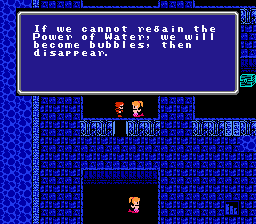
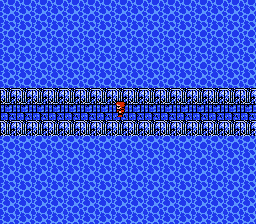
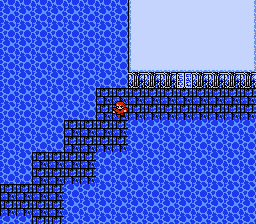
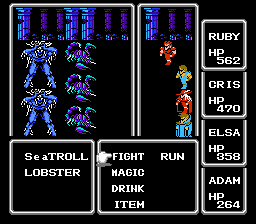
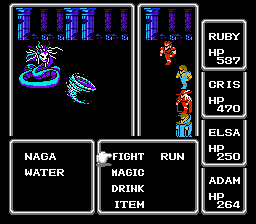
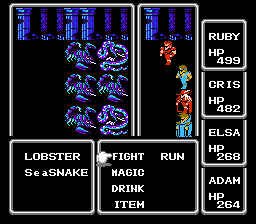
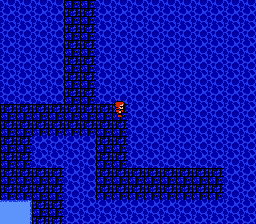
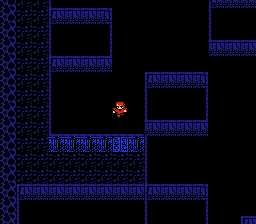
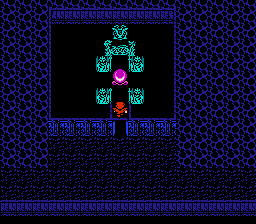
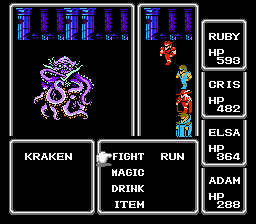
I never got that it was supposed to be OXYALE as in "ale, like that you drink, that provides fresh oxygen." I pronouced it "ox-YALE-ee" in my mind right up until this playthrough.
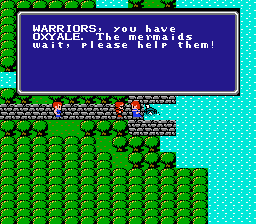
I very much like the female engineer wearing the dress who built the submarine that you take to the Sea Shrine. I never pegged that's what she is, but it is!
(The Pixel Remaster is besides the point of this project, but I have to note how completely it bungles the scientist. In the original, she's a confident, competent ally to whom the game gives the role of introducing formally the Sea Shrine and charging the party with their mission: "Warriors, you have OXYALE. The mermaids wait, please help them!" In the remaster, they clearly freaked out - "Oh, my God, the scientist is a girl in a dress!!!! That's impossible!!!!!! How can we ever explain this?!?!" - and decided that she's an ex-mermaid but is just so incompetent and overwhelmed and girl that all she can manage is a leaky barrel. She doesn't have any confidence in anything she does, and neither does the party. Awful. (I'll note in nested parentheses that the Pixel Remasters move toward a more unified sprite sheet for FF1–6, and its idea of a default woman seems to be FF4's Rosa, which extends to personality and appears to have resulted in a bit of wider rot in terms of character for certain female supporting cast members. Hilda from FF2 is similarly adversely affected, made flightier and breathier and more damsel-y and less sure of herself.))
Sky Castle & Preludes
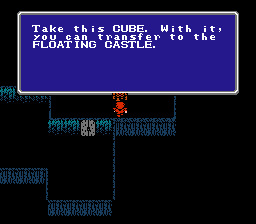
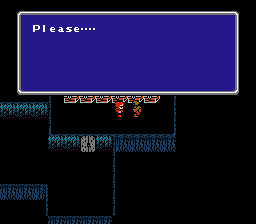
I've always found this "Please..." - all this robot can say after you take the CUBE that unlocks the Sky Castle - rather poignant. It's established the robots produced by the advanced ancient civilization that built the Sky Castle, left to fulfill worst-cast-scenario duties & duty-bequeathing their creators could not with their organic mortal lifespans could not, are breaking down, and all with which this robot is left after fulfilling their mission, seemingly succumbing to their internal circuits failing, is a remarkably human plea, one to empathy and pity.
In fact, I'll say this: watching John Wolfe's playthrough of the Pixel Remaster has made me appreciate how the original NES Final Fantasy makes use of its storytelling space. Final Fantasy has very basic quests, particularly by modern standards, after so many iterations in subsequent FFs - but relaying their twists and turns in one flavorful, lively window of text reframes them as efficient and respectful of the player's time...classic, yet with a twinkle in the eye and a song in their heart. It's another element that makes the game still appealing and strong today. The extra space the Pixel Remaster laboriously expends on FF1's plot developments, with a translation that's frequently charmless, makes the story seem exponentially weaker. Compare the NES's text upon examining a city fountain: "See your face upon the clean water. How dirty! Come! Wash your face!" The game rewards you with a small joke in an unexpected place (chiding the player with a mom-ish tone) for examining a routine piece of scenery. The Pixel Remaster's "Your face is dirty! Use this to wash up!" completely misses the joke and removes any point to the text being there in the first place.
The game, actually, has a surprising number of small jokes and funny or evocative bits of text:
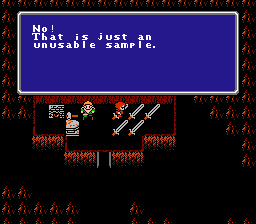
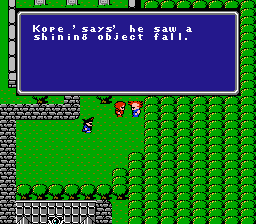
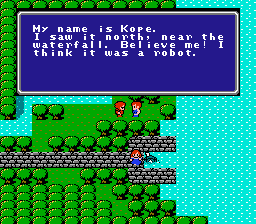
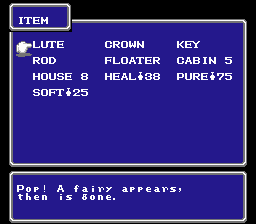
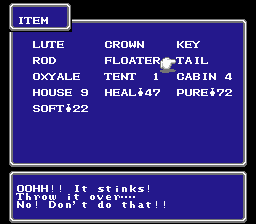
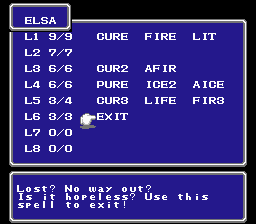
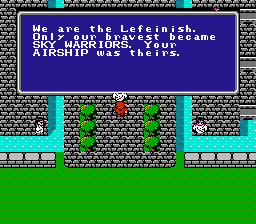
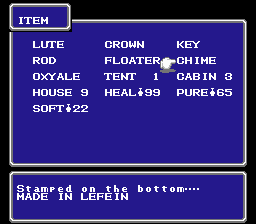
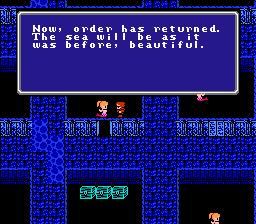
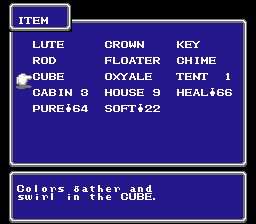
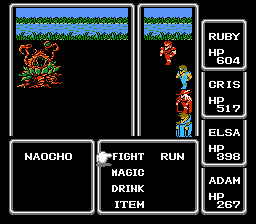
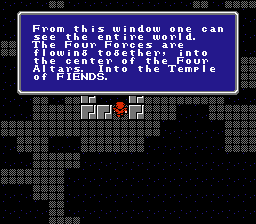
That last being your cue trouble isn't over once the fourth ORB is lit.
Anyhow: I completely forgot about the CUBE dungeon, as well as the CHIME tower dungeon - as well as the Lefein village itself, actually. (I was completely surprised to see it on the map and wondered what the heck it was, this "new" town completely unknown, I thought, to me, until I parked the airship and hoofed it in - memory had completely erased it from the quest itinerary.) Honestly, late-game Final Fantasy condenses - the last two Fiends, though representing nominally 50% of the quest, feel like a single, fractional stretch of the game. It's in part due to the aforementioned structure of the world map here, but it's also due to other aspects of the game changing, fading from relevance, due to your party's increased capabilities. The items you find in the Sea Shrine that can be used in battle for free spells (namely, the Zeus Gauntlet and LIT2) up your offensive capacity significantly. You just get stronger overall. Money ceases to be an issue, as your rate of earning it far outstrips your rate of spending it, and there's nothing left to buy - you'll probably hit the cap early in this stretch. Also at its limit: your inventory. Some of the party members use only one or two of their equipment slots, but the additional resource of a spellcasting item really puts the squeeze on those sixteen slots. Having to quit out of the Sea Shrine and subsequent dungeons repeatedly mid-looting every couple floors to sell your excess stuff is a very real frustration.
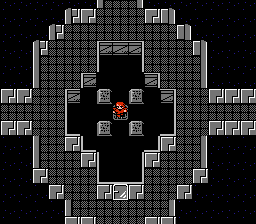
I like the sleek, futuristic look of the Sky Castle, among the stars. The soundscape that accompanies it is excellent. The devs make a huge effort to make it not of a piece with the rest of the game, a distinct, alien place - the unified sleek gray palette with smooth metal walls and mirrored steel doors contrasting with previous rocky caves and rough brick; the shiny light metal chests with raised edges and recessed sides; the inscribed walls completely covered with runes, marking this futuristic place as ancient still; the thin tiled floors, patchy from age in places, hanging out over the expanse of outer space.
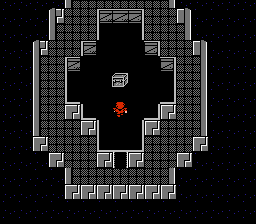
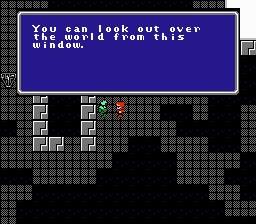
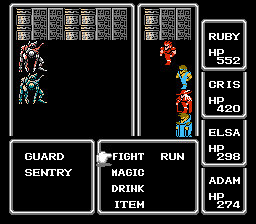
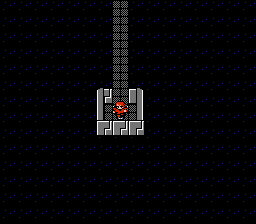
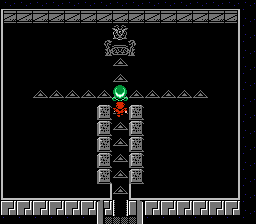
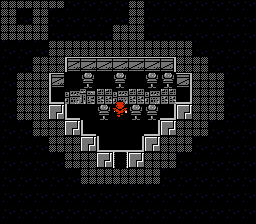
There are even computers with little padded computer chairs. (They 10 PRINT 20 GOTO 10 Tiamat glazing. Sebmal: "Did Tiamat program these?") You'd think this would feel shoehorned in to Final Fantasy, but it works exceptionally well due to how the location is presented and rendered.
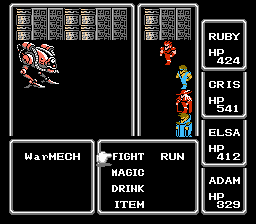
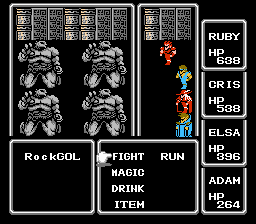
I fought WarMech, for the first time ever. We won with only one casualty (My Black Belt, I believe). It took a few rounds but (though powerful) didn't feel like a superboss; the game makes you so damn powerful organically if you explore thoroughly without relying on a guide. I recall that Tiamat put up more of a fight than the other Fiends (who were relative cakewalks) but did not present more than a moderate challenge.
The (Abrupt) End
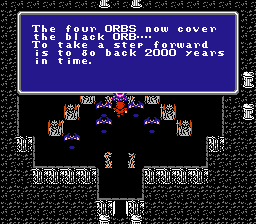
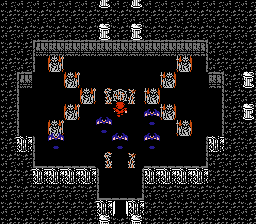
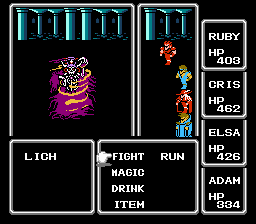
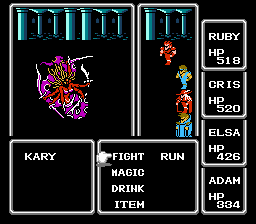
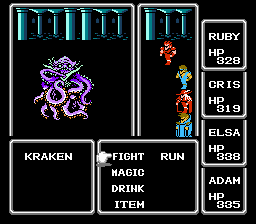
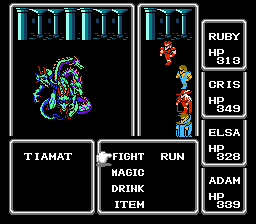
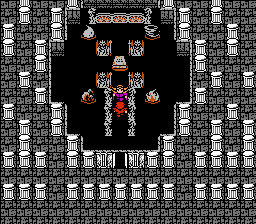
I regret to say that I did not take notes on the Temple of Fiends. I did it all in the first run, I believe. It was time to bring the game to an end. Healing was tight - the Red Mage's healing was limited in more ways than one, so I relied on potions, and some artificial prolonging of battles so that healing equipment could be used item-style. (The in-battle effects of some equipment become vital resources in the endgame, and yet I don't believe you're tutorialized on them - a rare such failure by FF1.) I missed the Masamune - I recalled from my childhood playthroughs it was on Kraken's floor, but resources were already getting scarce by then, so I didn't want to risk the trip it required. I wasn't even able to heal up fully for the Chaos fight, but the RNG gods thankfully blessed me, and I did not hit the turn in his attack cycle where he heals himself to full.
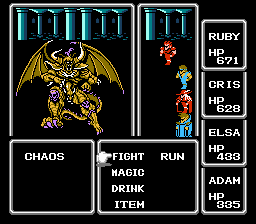
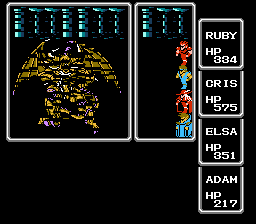
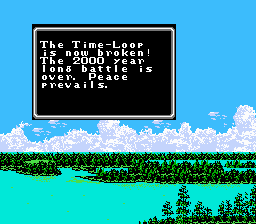
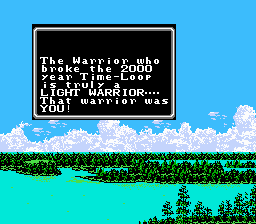
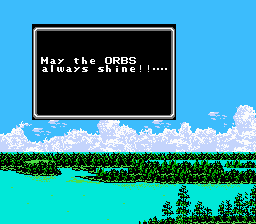
The ending is very happy to talk your ear off in a circumlocutious manner about the "Time-Loop," as if it's afraid you'll miss its cleverness. I'm sure they were proud of genre-busting and including a sci-fi element in a largely fantasy tale (with the presence of the Sky Castle foreshadowing the possibility of nonfantasy elements), but the Loop's not hard to understand (Party A gets sent to the past and does something that enables Party A to be sent in the first place), and it adds a bit of awkwardness to the ending. It's far from fatal, though - the bright colors and pixel art, combined with the proud congratulations from the well-written prose, paint a quite-effective picture of the world setting to rights and a sense of fulfillment after a long quest.
And as the Time-Loop brought us back to the beginning, I'd like to return to how this playthrough gave me a newfound respect for Final Fantasy's design. This was an excellent way to introduce much of the Western game-playing world to RPGs. It knows when to hold your hand - and it does so in a smart, respectful way that trusts in your powers of observation and deduction - yet it gives you ample choice in how to approach the game and control over your own destiny. It offers artistic flair on multiple levels to give imaginations young and old a handhold: bright, bold, and basic in its primary-heavy graphical style and its fundamental plot (the four elements are on the wane! Restore them to rights, one by one!) to be approachable, but with some sophisticated painting in the corners by the prose and Amano's outre art. In that previous post of mine, I mentioned that, at the remove of many years, I considered FF1 a good game in an "abstract" sense, but this replay made it clear that there's no "abstract" about it - it's a good game, period. There's a reason why this has become such a classic, replayed iteratively year after year by so many. It still entertains today, and despite my previous words in that blog post from the start, I'm glad I went back to it.