I've been playing games for over four decades at this point.
This is, without exaggeration, the most poorly-designed, poorly-functioning RPG I have ever experienced. It is misery to play.
Even if you haven't played it yourself, I've sure you've heard all the stories about the ill-conceived stat system where you can hit your own party members to increase your HP etc. I would like to emphasize that the lamented stat system represents merely the outer layer of bad decisions. There are, like, nine layers of bad decisions below that. There are numerous points in the game that seemed to indicate the designers had no idea how video games in general work, much less their own. There is a roadblock in the game (the Dist/Deist Cave) where it is honestly astonishing, worthy of intensive study, how every single bad decision in the game comes together to create a complete clusterfuck. It is astonishing. It is a masterpiece of incompetence that seems impossible to achieve without intention.
I will also emphasize that every single aspect of the game, from the battles to the world design to the constant poisoning to the utterly astronomical amount of grinding most spells (some of them mandatory for progress) take to become useful to the goddamn insistence on uselessly putting resurrected players in a position where they can't attack for utterly no player benefit, is designed for a maximal waste of the player's time. It is not content to be merely bad, like a Phantasy Star III. It wants to hurt the player.
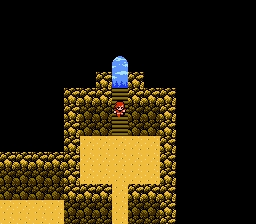
Before I begin the discussion in earnest, I'd like to get this out of the way: I did not use exploits. I attempted instead to approach the game on its own terms. Using the game's many exploits seems to be a ubiquitous method for dealing with the game's many issues: even the author of this playthrough, who was going for a more organic, fresh-faced "first-time player" approach to the series, knew about and used the Toad and no-armor exploits, used save states in the final dungeon, etc. I don't want to hear, "Well, why didn't you use exploits?" I was trying to show the game respect, engage with its systems honestly, and play it straight. Claiming my complaints are invalid because I didn't use exploits is a self-defeating argument. If you have to break the game to make it work, the game is already broken.
Presentation
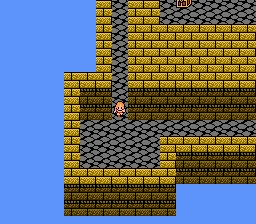
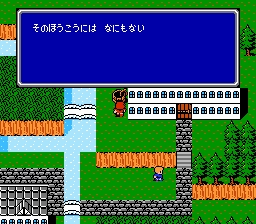
Presentation is one of FF2's lesser problems, and yet I find it to be an overall downgrade from the first game. Final Fantasy, a consciously basic game about the four primal elements, used strong reds, blues, and greens. In a seeming attempt to differentiate itself, FF2 shies away from those colors, opting for tints and hues from the Phantasy Star III part of the spectrum. Towns and their people tend to be accented in two colors instead of one, but the combos chosen - brown and pink; red and pink; orange and purple - are often unflattering. Castles, even those erupted from the depths of hell, have Pepto-Bismol-colored walls. The secondary party members, when shown on the overworld, are outlined but largely uncolored, depicted in white with accents of macaroni-and-cheese orange - they look unfinished, or out of a child's abandoned attempts in their coloring book.
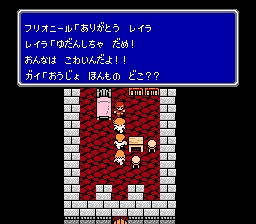
There's also a lack of shading on elements, or of little elements in the environments that tell of care (remember the statues in FF1 that would frame chests with really good loot? The computers with padded office chairs in Tiamat's lair?). What is here relies on cartoony heavy black outlines rather than FF1's detail in the tiles. The world just looks worse.
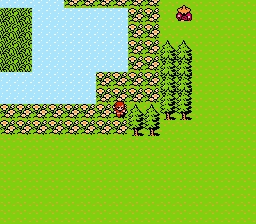
Following on the graphics front: one of the most memorable aspects of the first game was Amano's monsters. As the NES's palette was limited, Amano used outre shapes to make his beasts look bizarre, to energize the square spaces in which monsters were slotted. Their unique poses - and designs - gave them visual interest and character. There was art here, and it elevated the title.
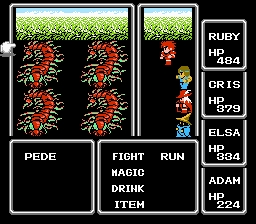
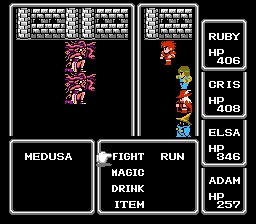
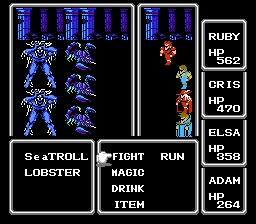
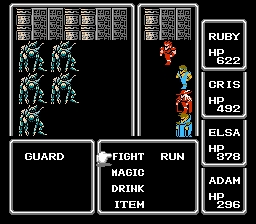
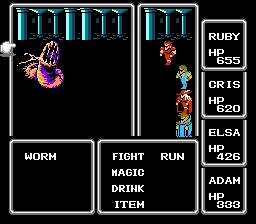
FF2's monsters tilt toward U.S. Saturday morning. They look cartoony, in a markedly Western way: goofy, rotting zombies with arms outstretched; skeleton warriors. They do have character, but it's of the Scooby-Doo villain ilk. The unconventional poses and dynamism from FF1 are gone.
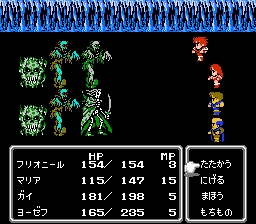
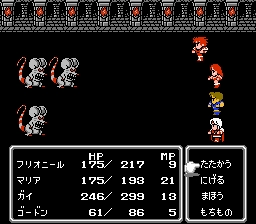
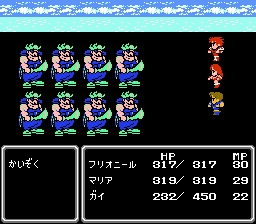
There are a few outre designs, like the Parasite enemies, but the foes here are less imaginative, goofier and more unsubtle, a point of distinction that FF2 surrenders. Again, FF2 suffers in comparison to its predecessor.
I don't think the music compares, either. The exception is the overworld theme, which is thoughtful and melancholy, befitting the game's subject matter and beyond the NES's typical range of expression. (Ray Hardgrit on the tone: "that makes sense seeing as we're the Survivors of Failure rather than the fabled Warriors of Light this time around.") The battle theme is uniquely awful due to this hideous falling-down arpeggio (I think I've used that term correctly) in the middle that sounds like an old clunker's engine dying as it tries to go up a hill. (They even featured it in the commercial! How could they be so confident? It sounds blatantly awful!) Much of the rest of the score is in this odd, off-putting tone that wouldn't be out of place in Nanashi no Geemu. (The Pixel Remaster version of that tune is fucking awesome, but we're not counting remakes here.)
I do like that commercial, though. It literally just shows the team working on the game. "Hey, you want the sequel? It's coming! We're working on it! Here we are! That guy's on his computer! That woman's consulting with that guy over designs! Here's a close-up of one of Amano's portraits!" It just shows the fruits of their labor (and their labor itself) to whet your appetite. No better endorsement! (Even if the final product was lackluster.)
The weaker score links to another problem: FF2 doesn't have memorable locations, and I think part of that is the music. When I think of the first Final Fantasy, the Sky Castle and Sea Shrine occupy a big part of my memories, and the location music really combines with the visuals to create something memorable. While the Sea Shrine music is used elsewhere, it's really suitable for going "down to the depths" here, to something beautiful but fading, and uncovering a potentially tragic story (the mermaids and their looming, then averted, fate). The Sky Castle music sets a technical, "high up" and spacey mood while being, like the castle itself, distinctly strange, not of a piece with what's come before. I think, say, the Whirlwind (you travel through a cyclone the Empire is using as a weapon) or the gargantuan Dreadnought airship dungeon could have been memorable in a similar vein, but scored by generic "imperial menace" tunes, the music doesn't elevate them to that status.
(I should note that the world of FF2 is notably short of wonders. You visit a lot of fortresses, jails, and caverns. It is, by choice, a more grounded tale than FF1, one focused on survival, conflict, and loss. It's concentrated on the human cost of war, what happens to the people when "great" people and powers execute "grand" designs with utter ruthlessness and illustrating that horror. I think, though, that a few wonders wouldn't have gone amiss, even if they were wholly natural - to give the journey a *little* visual variety, and give the world *itself* a little depth. As it stands, we have the Leviathan and the Dragoons with their Wyverns, and that's pretty much it. Even as I write this, the sentiment comes off to me as superficial and missing the point - that I'm complaining about a very human tale not being more fantastic or pretty. Perhaps I wouldn't have these thoughts if the central war story were wholly successful on all fronts. I will say, though, that the world of FF2 does come off as a bit small and shallow, the journey a bit monotonous.)
The Story
Now we're getting into an area with way more to unpack. Like the combat, the story's going for a moon shot, a big departure and step forward from the first title, but it falls short, into something in many ways lesser, because it doesn't have the groundwork for what it's attempting. There are a number of things I admire about the attempt, though.
FF2 is a story about war. It is about the cost of war and how it kills people indiscriminately. I do not believe I have played a Final Fantasy game (or, in some ways, a flat-out video game) that shows that with less reservation. Not even FF6 or Kefka can outpace FF2 or its villain in terms of sheer devastation. I have to discuss details, so I'm going to go into SPOILERS in this section from this point on.
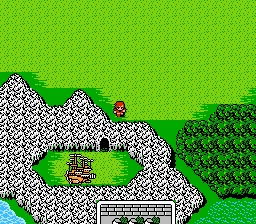
One of your earlier missions is to stop the Empire from building a massive heavily-armed airship known as the Dreadnought. This is the stuff of late-game threats in other titles, a populace-threatening superweapon. FF2 frontloads this threat - these are the pressures your side, the decidedly underpowered and losing one, is facing right from the jump - and the development likewise differs: the day isn't saved, and the weapon actually goes off. It's the illustration of the consequences, though, that's the biggest departure: the superweapon's targets consist of places familiar to the party, and most of the towns you're previously visited in the game so far will be subsequently depopulated. Places bustling with talkative townfolks will have one or two survivors; NPCs previously chatting up the local economy or flirting with party members are now able only to cry that they have no more home or their daughter is dead, everything they once were obliterated by grief.
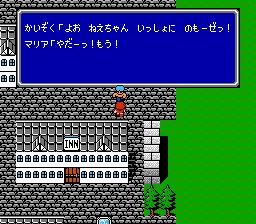
Maria: "No way! Ugh!"
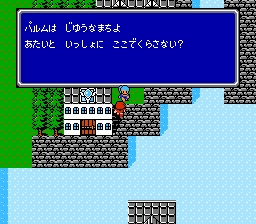
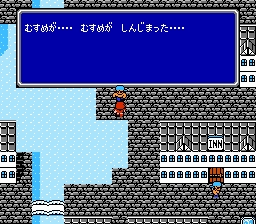
(The woman above is subsequently absent.)
That's the curtain-raiser. Later on, you'll come back to your home territory from a mission and discover the first four towns in the game just gone - reduced to rubble, wiped off the map without hesitation, ceremony, or immediate explanation. Even the populace of your recaptured homeland - last seen rejoicing in the comfort of coming home, in an apparent happy ending they once thought beyond their reach - isn't spared. The result of an Imperial offensive, of course, but the game's willingness to show the population of its world being killed in the war - without presage, without exception - is unprecedented and, to this day, nearly unparalleled. In FF6, you'll hear about Celes torching the town of Maranda, but you won't actually see it, and when you later visit the town, it's largely-intact and fully-populated. The folks in the World of Ruin are living under a miserable dictatorship, but they're living, and living largely-unchanged lives. Ordinary people die in FF2's war, by the truckload, and even your protagonist and his friends were spared this fate solely by sheer luck. The villain uses his power to kill indiscriminately, at grand scale. He does not care. No one is safe. The mechanisms are the stuff of video games, airship weapons and demons from Hell, but the ordinary people caught in the chaos are just as helpless as in real war, and there's no magic happy ending.
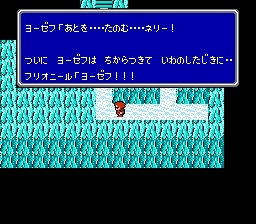
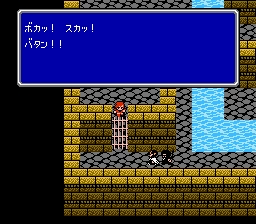
Narration: "Josef's strength finally gave out,
and he was flattened by the boulder..."
Frioniel: "Josef!!!" End scene.
Now: the game also attempts to illustrate the devastation of war with numerous deaths among your party members. This does not go as well. There game typically notes their departure with a single box of text, whereupon the party peaces out, and the world reverts to normal. The effect is more comical and jarringly amateurish than matter-of-fact "people die in war." I mentioned in my FF1 post how limiting its plot developments, to, most of a time, a single window of vibrant prose actually elevated its basic quests - made the game seems sprightly and classic instead of tropey. FF2 tries to transfer the same approach to character deaths (minus NoA's vibrant prose), and it flatly doesn't work. Death is common in war, of course, and there are ways, mentioned above and below, where the story leverages this fact well. However: if the victim was a trusted companion, then even if their death was sudden and brutally unanticipated, their friends - your party members - do need to react, breathing space is required, and appreciation for how this event forms the end of their story is necessary.
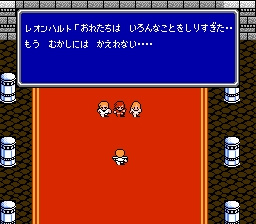
Here's the problem: FF2 wants to tell a character-based story, but it takes place before Final Fantasy discovered character development. Take, for example, Leonhart, your initial fourth party member and fellow childhood friend who disappears after the near-fatal attack in the opening and resurfaces as an Imperial soldier who rises to the rank of the Emperor's right-hand man. When Leonhart takes over the Empire after the Emperor's initial death and his identity is definitively revealed, the party's initial thought is the same as the player's: oh, he's been brainwashed by the Emperor.
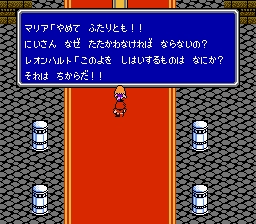
Leonhart: "What is it that rules this world? It is power!"
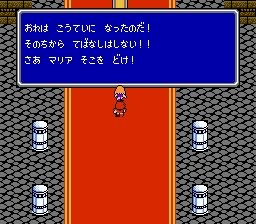
relinquishing this power! Now, Maria - out of the way!"
Interestingly, that's not the case. When the party confronts him, he confirms that he, in fact, is in total control of his actions and has chosen his path of his own free will. He instead professes that sheer power rules the world, and might makes right; he is simply following that imperative.
This promises to be interesting: in contrast to our core three heroes, whose losses have led them to attempt to defend others from undergoing such experiences, we have a character whose brutalization led him to believe, Vergil-like, that only becoming stronger could protect him, buying into the dog-eat-dog system and attempting to master instead of dismantle it. It's a huge upending of the usual good-guy-serving-the-villains trope. We don't get any exploration of that, however. There's no clash of values between Leonhart and his former comrades - the resurrected Emperor invades immediately after Leonhart's speech; Leonhart immediately joins forces with the heroes, after a bit of pleading from his sister, to take back his empire (presumably; even that's elided); upon their victory, he immediately departs, stating only to Frioniel that "they know too much" for things to go back to the way they were. The premise is interesting enough on its own to travel some distance, but, goddamn, the game doesn't do anything with it - have the characters talk; explore if there were something in Leonhart's background that made him susceptible to that philosophy. The plot point is just something that is, not something that's explored or evolves, and it remains a rich, uncapitalized story opportunity.
There's another sequence where the game does something genuinely interesting but fucks it up due to lack of development. At one point, you need to obtain a weapon you can use against the Dreadnought. The weapon is locked in a fortress that can be opened only by a) the voice of a member of the nation's royal family or b) a hard-to-access key-type item hidden deep in a cavern. Now, a member of that very royal family has been hiding out near the Resistance's base since the start of the game, his country likewise ravaged by the Empire. When this plot point rears its head, however, he disappears, leaving you no choice but to delve into the cavern. You get the item, but an Imperial trap claims the life of a loyal, brave ally in the process.
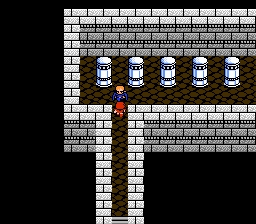
When you unlock the fortress, you'll find behind the door...the missing prince. He didn't skedaddle out of fear; when he heard about the situation, he actually ran to the fortress to get the weapon himself but was outclassed by the monsters within. His intentions were good, but the crossed wires led to a good man dying needlessly - for, essentially, nothing. The game's aware of it, too; the prince is an old friend of the noble and brave Resistance leader, Princess Hilda, and she subsequently rails him out precisely along these lines.
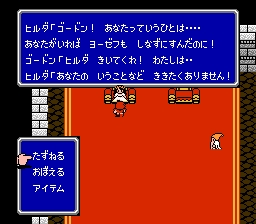
Gordon: "Hilda, listen to me! I..."
Hilda: "I don't want to hear ANYTHING you have to say!"
Now, I actually kind of admire this sequence. You're not used to such a development from a game; your people can near-always right wrongs through their sheer quality and make the good choice, and if they die, their deaths mean something - they're not just part of life being unfair or wasteful sometimes. It's one of the huge advantages games have over real life. Here, good people die not meaningfully, but because others made blunders or are generally just not competent enough. I commend Final Fantasy II for this. War's ugly and not fair, a horrible waste of life, and the devs want to show this to the extent they can in an NES RPG. It speaks well of the series that it was reaching so high so early in its lifespan.
The game totally whiffs on the followup. Shortly after this development, the King's health takes a turn for the worst. He hasn't been a significant presence in the story; he was wounded in the Imperial takeover of his kingdom and has been incapacitated since the start of the game. Leadership of the resistance has firmly been in the hands of Hilda, his capable daughter. The king's only scene of note is one where he laments, considering all that's been lost, that perhaps his country should've folded to the Empire. A human one, certainly, but hardly stirring or reassuring.
Two things happen, though. One: Final Fantasy II finally succumbs to the pressures of its era and renders its competent female leader the helpless victim of a princess kidnap plot. (The plot has her, with an uncharacteristic lack of wisdom, remove herself from safe territory in pursuit of part of the anti-Dreadnought weapon. Remakes and translations change Hilda's reasoning to be even more incautious, but in the original, I did at least find it sympathetic: she felt bad because she was always putting so much on the party's shoulders and wanted to lighten their load.)
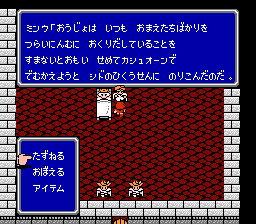
sending you and you alone off on arduous tasks. She took off on Cid's airship,
thinking that at least she could meet you at Kashuan."
Two: right after Hilda's apparent rescue, the king begins to succumb to his wounds and finds himself on the verge of death.
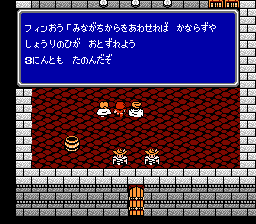
I leave the rest in the hands of you three."
Hilda is not even present during her father's deathbed scene; she instead shuts herself up in her room, doing something that could be construed as weeping. (We later learn that we have not, in fact, rescued Hilda but instead a disguised monster, and that she was not weeping but, in fact, laughing to herself. Regardless, Hilda, the king's daughter and heir as leader of his nation, is not a presence in her father's dying scene.) Instead, the king calls upon our hero Frioniel; Minwu, his court's loyal, brave, and competent White Mage; and...Gordon, the prince embroiled in the snafu above. Frioniel and Minwu are charged with quests deemed vital to the rebellion's success, but Gordon, after being praised to high heaven for his alleged leadership and heroism...is enshrined by the king as the rebellion's leader, replacing his daughter. From then on, Gordon sits on the country's throne and gives the party orders. Hilda, when she is rescued for real, sits alongside him, but his authority remains.
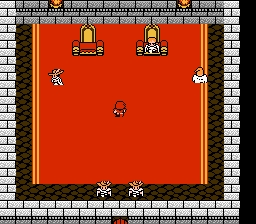
As I've said, I admire how FF2 makes its cast human and fallible, and I'm not saying Gordon should have been on the outs forever. He does go on the mission to rescue (the fake) Hilda and blow up the Dreadnought, yes. As vital as it is, though, that's one short mission - one accomplished primarily by Frioniel and your other mainstay party members, Maria and Guy, who have a far longer list of impressive feats and were clearly carrying. To have a man who was last seen, in his only illustration of character in the entire game, claiming that his country should be licking the Emperor's boots holding up Gordon as, now and always, a shining example of leadership and heroism and, in a scene treated with the reverence of a sacred charge, enshrining him as the leader of his country and the resistance while kicking the woman who's actually embodied those values to the curb is...well, Jesus Christ.
Yes, I can see where they wanted to take Gordon - or, at least, where a more competent Square further along in its evolution would have wanted to take Gordon: from his initial bewilderment and depression over what to do after losing his family and homeland; to panicked and ineffectual attempts to help that are well-meaning but get others killed; to continuing his attempts at helping and eventually gaining strength, confidence, and leadership abilities; to becoming a genuinely positive example for the resistance and claiming a position of leadership. Again, though: FF2-era Square hasn't yet discovered character development, so they don't do the work required for this arc, particularly for the third step; they just pluck Gordon up and plop him down at the finish line. What was once a really good idea becomes an extremely bad one.
(This applies to a lesser extent to the king; it's understandable that a leader would have second thoughts about a brave but costly act that has involved the deaths of many of his people, but you need to define these thoughts - which are, after all, treasonous - as a lapse and not the single thing that defines his character before setting him up as the rebellion's moral example and guiding light all along. It'd be harder in the king's case, because he is incapacitated, but you could have, say, his court establish him as a wise and able ruler prior to the invasion through NPC dialogue. The story handling also ignores one of the tale's few examples of proper characterization work up till that point: Hilda's consistent presentation as a wise and capable leader, your mission's guiding force and pillar.)
There's a very strong tie between FF2 and my beloved FF4. The roots of many of FF4's story elements can be found in FF2: the world's center of magic being a town named Mysidia; the Dragoons, represented in the party by a dragon rider with the last name of Highwind; a bare-fisted fighter - bald, with a moustache - who bears a significant physical resemblance to Yang (with a blonde daughter, hair in twin buns on the side, who seems the physical template for Yang's daughter in the lamentable After Years); an interlude where a sea voyage is interrupted by an attack from Leviathan; the brother of one of the main characters being a high-ranking commander of the enemy forces and figure of darkness, the revelation of his identity being a huge twist, and him subsequently defecting to the side of good to questionable success. FF2's failures when it comes to character moments and character-based stories, however, make clear the nature of FF4's story-based triumph: it discovered character development, essentially. It understood, where FF2 didn't, that it had to invest in its characters, and that the big moments demanded build-up, and payoff. The stumbles here led to triumph in FF4.
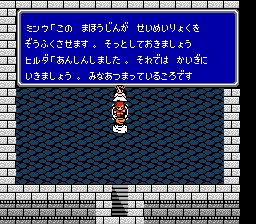
Hilda: "This is a relief. Let us proceed to the meeting. Everyone should be gathered."
One more thing, going back to Leonhart's line about the party "know[ing] too much" for things to go back to the way they were. I liked how FF2 kind of deemphasizes your party. You start the game getting torn to pieces, like the rest of your village, by Imperial troops (depicted in a no-win battle where you get curbstomped by late-game enemies). You're saved only by the very fortunate, chance intervention of more powerful forces. Your first few missions are relative grunt work: sneak into the conquered city to see if your missing friend's been captured; find a source of metal for the rebellion to make weapons. Even at the end, you're not some invincible Chosen Ones; you're just the lucky bastards who beat the one-in-a-million odds to make it through, the way to your victory paved by the sacrifices of countless, possibly-better people, loyal comrades shown giving up their lives for you in-game. It dovetails well with the "powerlessness of the populace during war" theme.
The translations and remakes don't quite get this; they treat your nonspecialness as something to remedy. The Pixel Remaster goes on about the hero's special "destiny." Both the Remaster and the fan translation rewrite Leonhart's parting line into "we know too much about each other now" - meaning, not "war has changed us irreparably and we can never reclaim our childhood innocence," but "this conflict was naught but a forge and stage for our incipient manliness." The GBA adds another campaign - very well-liked and popularly-lamented in its absence from the other versions - where you take control of the fallen characters in a quest through the afterlife*, because it's weird that they died and left the narrative before their time, y'know? (The problem is with the execution, not the deaths themselves.) FF2's a disaster, and the story has numerous big problems, but in a way, it's still ahead of its time, its accomplishments in this arena misunderstood.
*Two things about this quest: 1) The afterlife is indistinguishable from the living world, organized around RPG hamlets and everything. This reminds me of how the Doug movie depicted VR: a perfect render of the physical space you already inhabited, except everything was more expensive. 2) The concept is that the Emperor's soul, upon death, split into two halves, a good half and an evil half, with the evil half going on to conquer hell. But, wait - the Emperor is so evil that the good half of his soul is also evil, and so the characters have to stop the good-but-also-evil half of his soul, who has taken over heaven. That is so completely stupid that it wraps back around to being brilliant.
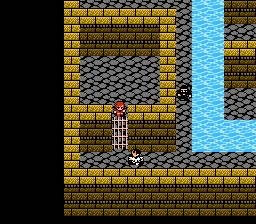
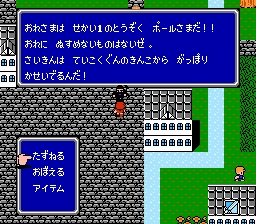
Recently, I've been helping myself to the Imperial army's vaults!"
Okay, one more thing. The best character is a ninja named Paul. I could stop right there in making my case, but Paul saves your party's bacon in a few circumstances and has a cocksure, self-interested attitude that's a welcome contrast to the game's weighty proceedings. Paul has a completely different Baka-ouji Noble Pantaloons character design in other versions of the game, but here, he is totally Paul in head-to-toe black ninja pajamas. I could only envision him as a typical '80s white boy American ninja, usually, given Paul's 'tude, Ninja Brian from Ninja Sex Party. That made for one bright light in the darkness.
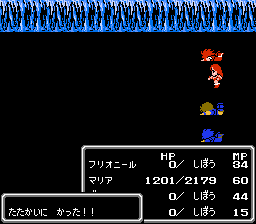
but near-everyone collapsed dead on the floor is very much the aesthetic for this game.
The Gameplay
OK. Hoo boy. Here we go.
FF2 has so many bad decisions in its gameplay that it's impossible to find an optimal starting point to discuss them. I'm just going to jump in by listing bad decisions.
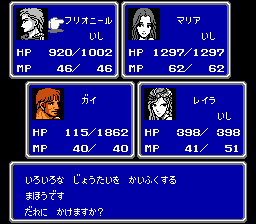
- While the game technically allows you to spec your characters however you like, it really likes making all possible specs but one unworkable. Magic, for example, is completely nonviable. Due to how the game handles stat increases - what you use increases, and what you don't atrophies - you need to have someone dedicated to magic use - all magic, all the time; no physical attacking - in order to have the INT or WIS to make magic work. Even at those levels, though, magic is still basically nonviable; it seldom does as much as physical attacks, and at those still-learning levels, it just sucks.
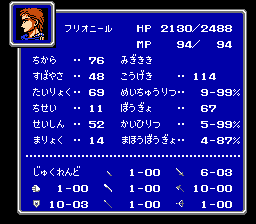
- Another example: there are seven different types of weapons. Party members become more capable and able to land more hits with a certain weapon type with use, so you can't switch between weapon types at will; they have to spec into a certain type. After a certain point in the story, however, axes become the only viable weapon type, the only category that does appreciable damage. Guy, my dedicated axe-user, was hitting for 300, 400, 500+ HP when my sword-wielding Frioniel was hitting for, like, 30. With magic permanently sucking, the only solution is to turn every party member into an axe-based attacker. Even an axe neophyte with starting with no axe experience was doing 100 damage each turn. It is ludicrous.
- Despite that, the game will feature challenges and enemies that be overcome only with nonviable means of attack. A few early bosses can be attacked only via magic - OK, not a great decision, one that may require a reset, but the nonviableness hasn't completely set in by that point, and you likely have that spell. However, there are a few areas in the mid- and late game where the enemies can be damaged only via magic, and will take five or so hits of a certain spell to take out. It's possible to win these battles, but it takes freaking forever, with routine combat grinding the game to a complete standstill and each random encounter taking upwards of five minutes to resolve. (And magic sucks so much that I can't imagine it's much faster even with a fully-specced magic user.)
- FF1 had a frustrating mechanic where it put poisoned characters at the end of the roster, where they were less-likely to be attacked. You're going to cure poison immediately rather than let it drain your health, so the mechanic was just an annoyance that forced you to reorganize your party, but if you forgot - unlikely, since your lead character on the overworld would likely change, since the leading and most-frequently-attacked character nearly always got it in any poison outbreaks - your party was still battle-ready; it just meant your squishier characters would be attacked more from the lineup scramble.
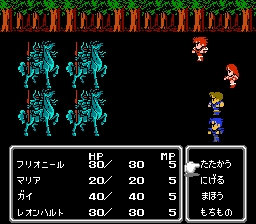
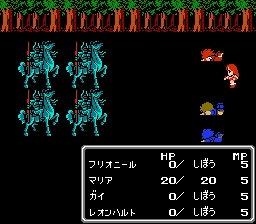
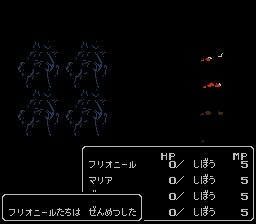
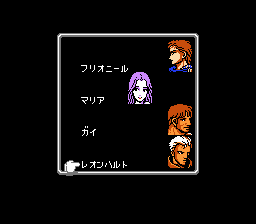
FF2 puts any character who's been rezzed on the back row. Being on the back row means you can't attack. While those on the back row receive a degree of protection from enemy attacks, they are rendered useless in battle, incapable of attacking by any means but magic (and allegedly bows, though this didn't work for me). Because healing magic, even at endgame levels, is so woefully ineffectual, it's an entire goddamn process of seven to ten heals to get someone healed up and functional again, and by that time, I normally had completely forgotten the "hey, put them in the front row again" thing. As a result, I'd go back to the overworld, stumble into combat, and find that a battle I normally would've been able to handle easily but was now unwinnable and demanded a total game reset because someone was in the goddamned motherfucking back row. - Basic consumable items like potions no longer stack: each single potion, Gold Needle, etc. takes up its own item slot. You have a grand total of 33 slots. Furthermore: each key item you gain permanently takes up one of those slots, so your item capacity reduces as the game progresses. Furthermore: this is the FF that introduced the whole panoply of condition-specific curative items (Maiden's Kiss, Crucifix, etc.) for status effects.
FURTHERMORE: Esuna in FF2 varies in the conditions it can heal based on level. (This is not explained in-game; you need outside info. Other spells like Life have a lower chance of working, or working in certain conditions, based on RNG, so you might initially believe yourself unlucky when your heals fail; with Esuna, though, it actually is a hard level-based limitation.) Stone, the game's most common and debilitating ailment, requires a level 6 Esuna to cure. I was at level 3 by the end of the game. Further furthermore, you cannot level Esuna unless a party member is actually afflicted by a status ailment. Unless you cast Blind on your own party members, then heal them, you can't level the spell willfully. Even at the endgame, I had to give up valuable pieces of equipment and offensive & curative items to keep a few Gold Needles in my inventory.
What's more: the devs introduced a whole array of items in FF2 that cast spells indefinitely, or semi-indefinitely (with a small chance of breaking per cast)! You'll never be able to engage with that system. The space is too precious to waste on experimentation - i.e., to have fun. - There is an entire weight mechanic with armor that goes completely unexplained. (Not even in the original Japanese manual. I checked.) Equipping certain pieces of optimal armor will tank your evasion so you can no longer escape from battle or take your turns before the enemy. You need to stick to lighter but less-protective cuirasses and hide equipment if you wanna be agile. Now, this would have been actually smart and innovative if it had actually been explained. As it stands, you'll just figure that evading and escaping battle are two more parts of the game that just don't freaking work.
- Equipping heavy shields, however, will increase your evasion. Shields do nothing for your defense.
- Equipping certain weapons will decrease the effectiveness of a character's magic, which is already cratered. Bows - a weapon associated in the franchise with one of its headliner White Mages, Rosa, and touted as the only weapon able to hit from the back row, where you would keep a mage, though, again, this was not my experience - are the worst in this regard, slicing off a whopping 70% of a spell's effectiveness if equipped to the caster. (I know the Rosa thing is retroactive, but, man.) Maybe try shields, as under the game's rules, attacking physically with a caster is flatly discouraged? Nope; they also take off 70%. Again, this is completely unexplained. The player is not notified of it in any manner except mysteriously-ineffective spells.
- You can equip two weapons, but you cannot attack with two weapons, even though the in-game animation will show you doing just that. Only one of your weapons will have its damage registered. Again, this is never explained, nor is it explained why you are allowed to equip two weapons if you are not allowed to attack with both. (One of your party members even comes equipped with two weapons, just to puzzle you as to why she's not doing more damage.)
- MP is an extremely limited resource. MP recovery items are nigh-unaffordable until the very late stages. Even in the early dungeons, there are enemies who will completely sap your MP with one attack.
- You can lose stats in this, and lose them fast, if you spend a turn in combat doing something outside your designated specialty. No allowances are made for special combat conditions (having to use magic against enemies impervious to physical attacks, say); even one turn can reset all your progress. Even if you find the "become proficient in the combat actions you perform the most" system a good idea, the sensitivity is set way too damn high.
Furthermore, there are inexplicable events that can change your stats for no perceivable reason. My Frioniel began gaining Spirit (FF2's Wisdom) in the late game with every battle despite casting absolutely no spells in battle. - Unlike in FF1, there are usually no geographical boundaries separating low-level from high-level areas. You can, and will, stroll unwittingly into endgame monster territory. You likely will unable to run due to the unpublicized armor thing. The game's way of telling you you're not where you're supposed to be is instadeath and a forced reset.
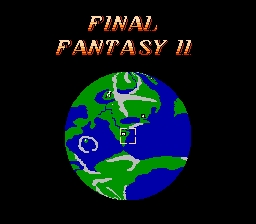
- The world map sucks. I mean that in both senses. The major land mass wraps completely around the world and bifurcates to prevent you from sailing east or west to get to the other shore quickly - you have to maneuver around the non-wrapping leg and negotiate this horizontal Panama-like isthmus trapping you in to get anywhere. It takes forever to navigate to places and makes the map confusing. You have a TCELES B HSUP map at your disposal, but the devs decided to make the continents curve in real time on the NES, mapped to an actual globe you turn, and while this is graphically impressive, it's also way more than 8-bit can handle, as it rotates one 10°-slice every five seconds. Navigating the world of FF2 just sucks because of all these decisions.
- Spells are painfully slow to animate (and don't even have the grace to look good while doing so). Furthermore, the animation plays out individually for each participant hit. Battles are like pulling teeth.
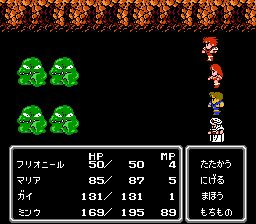
I'm probably forgetting, like, ten outrages, but this is a start.
Looking at it, I think the issues above can be grouped into three general categories of problems:
- The game has secret mechanics that are not explained in the game itself or in the manual and so are counterintuitive or obscure. (Ex.: The armor penalty, penalties weapons carry for magic, allowing charas to equip two weapons but not attack with them, the function of shields - though this last is explained in the manual, it's so counterintuitive it needs something beyond that.) This produces a lack of understanding on what is needed to succeed. I should point out that these misunderstandings almost never work out to the player's benefit; they near-always produce punishments and setbacks for no discernable reason from the player's perspective.
- The implementation of systems that are sound in theory is faulty, usually due to extreme overreaction or overtuning of systems. (Ex.: Axes becoming the only viable weapon; stats resetting if a character steps once outside their prescribed role; characters who've been downed being rendered unable to attack even after they've been rezzed; inventory limitations that zoom past strategic into irrational and that prevent player participation in entire systems; treading into new territory ahead of schedule resulting in instadeath.) This produces disproportionate setbacks that feel particularly unfair and frustrating on top of the setbacks imposed by 1).
- Things take way, way, way too long. (Ex.: Negotiating the in-game map (either one), battles that rely on magic to resolve or where the enemy casts magic a lot.) This just prolongs the pain of the game's bad decisions.
Some possible solutions:
- Inform players of your new and unfamiliar systems so they can make informed decisions and engage with these systems fully. Preferably in-game, since some of them are so counterintuitive, but the NES era ain't about that in-game tutorial lifestyle. The information needs to be somewhere in an official, available-with-purchase capacity, though.
- Don't make the penalty for failure so severe, or the bar for success so high. Don't dock stats so heavily if a chara spends one battle on actions atypical for their class. Don't make magic suck so much. Don't go against your own systems and refuse to increase character MP in a difficult dungeon that requires a lot of spellcasting. Don't, in a game allegedly about player customization, make a single method of attack ridiculously OP and the rest utterly nonviable.
- Have a basic investment in how your decisions affect the player experience, particularly in regard to time spent and wasted. Don't make the map a chore to explore. Don't make combat decisions that extend random encounters past all reasonable length.
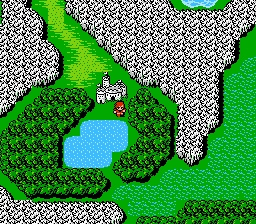
This all culminates in what, without exaggeration, is the worst-designed sequence I have ever played in an RPG. Once you get a ship of your own, you're ordered to go to the island of Dist (Deist in English versions) to attempt to get the help of the Dragoons. In short order, you'll find yourself tasked with getting to the bottom of a particularly winding and grueling dungeon. The encounters individually aren't unmanageable, but there are a lot of them, and I find myself running out of resources. Particular problems: 1) My weapons just aren't hitting for as much as they should. They feel one level behind. 2) The dungeon's random encounters include enemy groups featuring foes that can be damaged with magic only. Spells suck in the best of circumstances, and mine double-suck - my spells and magic stats are unleveled, because magic isn't a viable means of standard attack and takes extraordinarily long to level, and the game isn't forgiving enough for me to futz around and waste turns with worthless attacks, particularly not for nigh-all eternity. What's more, using magic for attack cuts into my healing & recovery resources. (Ethers are prohibitively expensive at this point, and with my cramped inventory and the status-recovery items I have to carry due to Esuna's limitations, I wouldn't be able to take many even if I could afford them.) If I run into too many groups of these enemies, I effectively run out of resources for the dungeon before my time.
I have no options to improve my situation, however. I already have the optimal gear from all the locations on the map. I cannot grind to improve my stats, though, because battling the monsters in the cave - the toughest monsters I can feasibly defeat at this point - does not improve my stats. How much of a stat boost I normally get from defeating monsters depends on their "Rank" - basically, an assessment of how dangerous the game thinks they are. The monsters in the cave at Dist seem to be misclassified as a lower Rank than they should be - despite giving me a tough time, I'm not getting stat points for defeating them. I'm also not getting additional MP - I can cast spells till the cows come home in Dist or elsewhere, I can exhaust my MP pool, but I'm hard-capped at 30 MP. I cannot expand my inventory. I cannot gain additional resources to tackle this dungeon. I can do nothing as a player to improve my situation.
(I should also point out that each battle against the magic-only enemies is absolutely grueling and takes five minutes to clear due to the glacial magic animations. This establishes a trend: the game not only wants to make you suffer, it wants to make you suffer at length.)
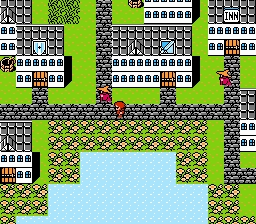
...However. I recall, as I mentioned in this post, that when I first played the game I possibly found Mysidia early. I haven't been asked to go to Mysidia yet, but what if I sequence-broke and got some advanced equipment to make it through this dungeon? The game isn't giving me any other options.
Well, Mysidia isn't marked on the map. (This is intentional, because it's a big oooOOOoooOOOOoooh mystery city.) You just have to kind of find it on your own. And you've got a whole wide world to explore! Unfortunately, exploring that world is a huge problem. For one, as detailed above, the physical design of the world is contrived to frustrate exploration, make it as laborious and inconvenient as possible. The map you're given in the game is no help; it takes an impractical amount of time to load. For another, remember: if you happen to set foot on land you're not supposed to be exploring yet, the game puts you in an inescapable, unwinnable battle. You can reset after each failed landfall...but having to explore the entire world through constantly resetting your game is impractical timewise. It makes for an extraordinarily frustrating, teeth-grinding process. (Again, we're sequence-breaking...but the game flat-out isn't giving me the resources I need to meet the current challenge and is outright blocking any of the typical routes I would use in an RPG to expand my resources or capabilities.)
I dealt with this clusterfuck the way my Nintendo Power childhood taught me: for the first time in the run, I looked something up. Namely, the location of Mysidia, located inland on one of the southern continents with no defining landmarks near its landfall. The only other time I did this was when I began using maps in the final dungeon, after floor 15 of 20, upon learning that the game puts enemies that can single-handedly instakill your entire party in one turn fifteen floors and 90 minutes in. I felt no shame then, as I did not here. The game is being unreasonable and inscrutable to a human mind, like with the tornado debacle in Simon's Quest.
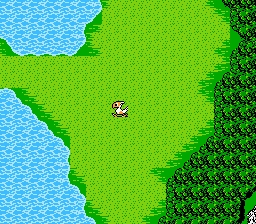
(An additional frustration: the game doesn't reward alternative solutions. In looking up Mysidia's location, I was reminded of a chocobo forest south of Gordon's fortress that, at the time, had no discernable purpose but is actually directly north of Mysidia. Of course! I thought, in the manner of the gif of Willem Defoe slapping his forehead. They wanted me to ride a chocobo down - I could have skipped the instakill battles that way! But, no: there's a stream to the north, unfordable by choco-kind, deliberately blocking off approach by yellow ostrich. They want you to head into the instakill battles. They don't care if you were clever. They're not interested in rewarding you for engaging with the world and task at hand.)
And when I finally got to the deepest depths of that cave, here's the kicker: the chests were still giving me the old equipment. The equipment that was doing a piddling 10 damage at the start of this debacle! The devs thought this woefully-inadequate equipment was not only a suitably-powerful reward for making it through this nightmare but represented an upgrade over whatever you used to make it through. It's as if FF2 had no idea what was going on in itself.
That's the problem with FF2 - it's dumb in this malevolent way, where it crosses off anything you might use to help yourself, but it refuses to give you a hand up or see that maybe something in its design isn't working. Everything is put toward preventing the player from helping herself in a non-approved way; nothing is put toward ensuring the planned solution is viable or working as intended, when at times the slightest bit of thought would reveal that the design is utterly stupid. And the game is happy - extremely happy - to waste your time. This is why, I think, exploits prevail. Players show no respect to the game, because the game shows no respect to anyone.
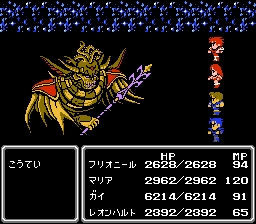
the basis for "Love Will Grow," is lovely.
I've seen folks try to be Unique and Cool and Hip and With It by trying to champion FF2. I'm glad, in a way, I played it, because now I have the knowledge to discuss it usefully, and it is, in many ways, an interesting failure, an important and instructive failure in the history of Square's development - but it is a failure. The game's received a number of more-playable remakes over the years, but the real definitive version is this wretched thing. And sometimes, the bad thing is actually bad. Final Fantasy II, despite its ambitions and successes in the story arena, is bad. It's not useful to pretend otherwise.
