
Note: I discovered recently that the initial installment on my planned series on GAMES Magazine's odd choices for Game of the Year is actually one of the site's most-visited articles. I wanted to revisit the series - and to my pleasant surprise, I found a set of complete scans and a complete analysis of the main article from three years ago in the recesses of my hard drive. They are posted for your enjoyment here unedited.
I'm not sure why I never posted the article, but I can make a few guesses. One, there's a light streak in some of the scans on the side, and a bit of stray paper that appears in a few images. I'm sorry, folks, but I can't redo the scans right now. Those are staying.
Two, I note in the article that this edition had a few extra features I wanted to cover as well, including a short separate article on games for kids and a feature on interactive movies. I hadn't gotten around to scanning those - I vaguely recall I wanted to fix the streak issue. For the time being, this post will be restricted to the main Electronic GAMES 100 article. I'll go back, but it won't be soon.
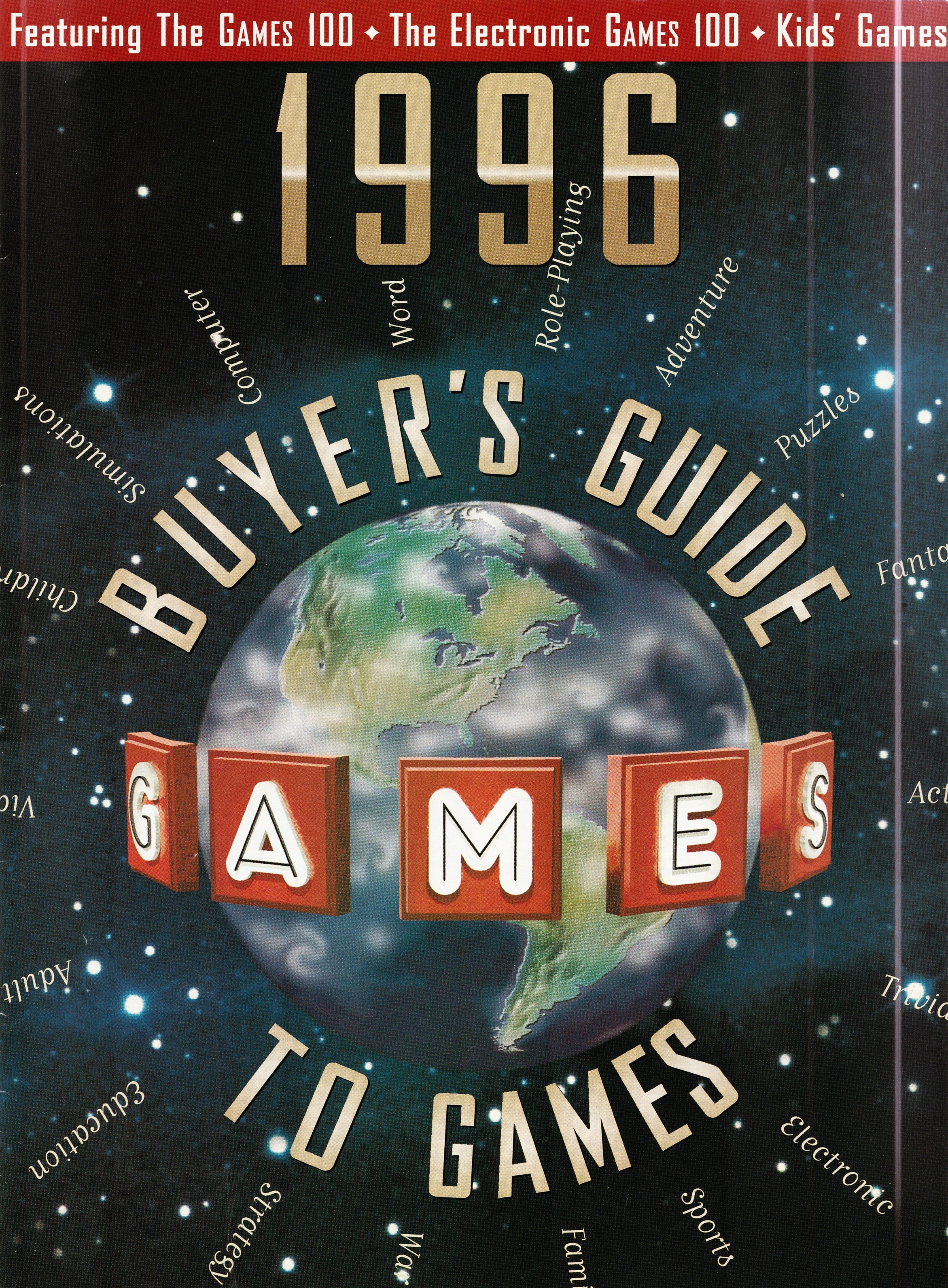
A true extravaganza awaits us.
Coming out in the U.S. this year: Panzer Dragoon, KoF '95, Street Fighter Alpha, Virtua Fighter 2, Earthbound, Phantasmagoria (it was huge at the time), and a little game called Chrono Trigger. Past GAMES's late-September deadline (discussed in previous installments), we have Donkey Kong Country 2, TIE Fighter, and Gabriel Knight II.
So what won? You're never gonna get it, motherfucker. You're never gonna get it in a million years.

VIRTUAL
POOL.
You'd be forgiven if you've never heard of this freaking ever - it was the first in a small franchise of pool titles launched in '95 but left behind by the turn of the century, with a brief revival about 10 years ago through Steam Greenlight. A cursory glance through Wikipedia info and old magazine scores indicates this first Virtual Pool was generally well-regarded, but it didn't seem to get enough traction to break out into the larger, non-sports public consciousness. No installment except the ancient-by-Steam-standards 4 is commercially available, through GOG or elsewhere. That's to be expected for an old sports game, but it also underlines what a bizarre choice GAMES made. A Game of the Year with no footprint on the modern commercial market whatsoever?
Perhaps an explanation would be more apparent if Virtual Pool were a multimedia extravaganza, but, well...this video showcases the first installment's untextured polygons and MIDI ragtime in action.
GAMES' argument basically boils down to: "It's just a really good game of pool." Like many from those old reviews (apparently; except for GameSpot, I'm relying on second-hand Wikipedia info), GAMES is exceptionally impressed by its apparently-unprecedented physics engine, which allowed for an evidently-satisfying recreation of actual ball physics, which, when combined with the allegedly-lifelike controls (you pull back on the mouse to pull back the cue; the movement's just like in real pool!), made for an exceptionally-realistic simulation. Apparently.
I don't know. I've never played pool proper, am not qualified to judge simulations of it, and have no knowledge of the history of simulations of the sport before or after Virtual Pool. For what it's worth - and, again, according to Wikipedia - the reviewers at PC Gamer said the office couldn't keep their hands off it, so maybe it was really that good. A part of me still says: Game of the Year, for just a good game of pool? (And another part of me retorts: would you object if it were just a good game of baseball, or just a good game of football, or any of the other sports better-represented by more mainstream, conventionally-awardworthy titles in gaming at that point?) As observed previously, gameplay was king at GAMES, and they didn't really grade for ambition, or, given their limited knowledge of the video game field, have any way even of recognizing it. (Witness their giving the Puzzle category trophy one year to a simple, limited-feature jigsaw shareware title.) They were perfectly OK with awarding their laurels to a run-of-the-mill title if they happened, for whatever reason, to have had the best time with it, even if that title were very limited in scope, or had significant problems, or didn't really break any ceilings for the medium. "Just good" was enough to be the best. I can't say that's not valid, but I think there's some place in these awards for knowledge of the state of the medium, of what's been accomplished and what's groundbreaking, of what's both accomplishing its goal well but also setting a goal that's a little higher than "just good." But then, we've had this conversation before.
While the game is hardly unique in these respects and there's a dice-rolling element here, much of Virtual Pool's victory can be chalked up to it ticking the boxes on the GAMES checklist. It's a representation of something the layperson would consider "adult," not jumping plumbers and exploding spaceships; it showcased 3D graphics, which were considered by default wowee at the time, no matter how primitive they were in execution; there are multimedia accoutrements on the disc, such as actual videos with real people you can play. Virtual Pool's victory is more a sign of the times: how general amazement with new technology was enough for Game of the Year in 1995.
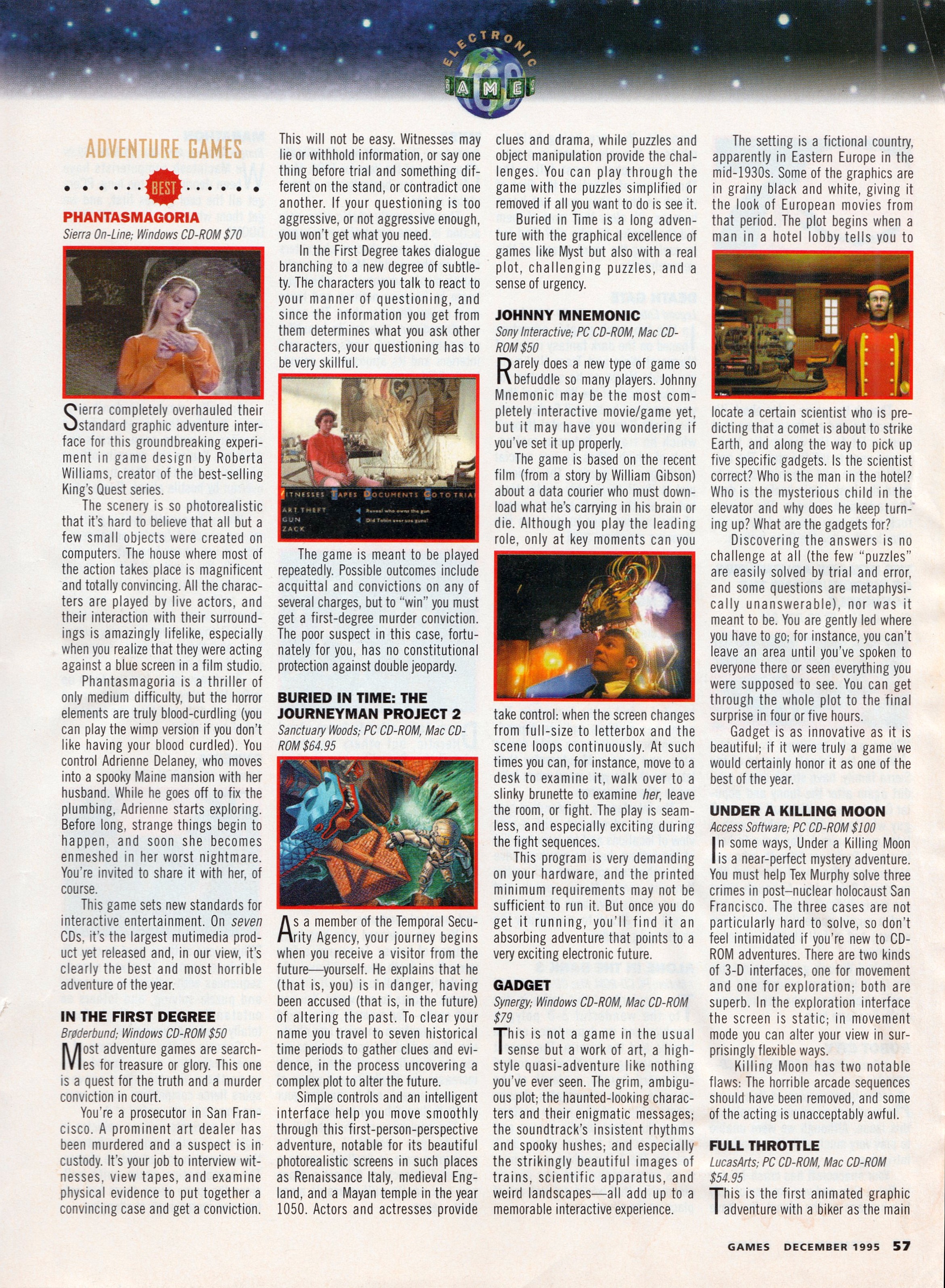
Yep, here's Phantasmagoria.
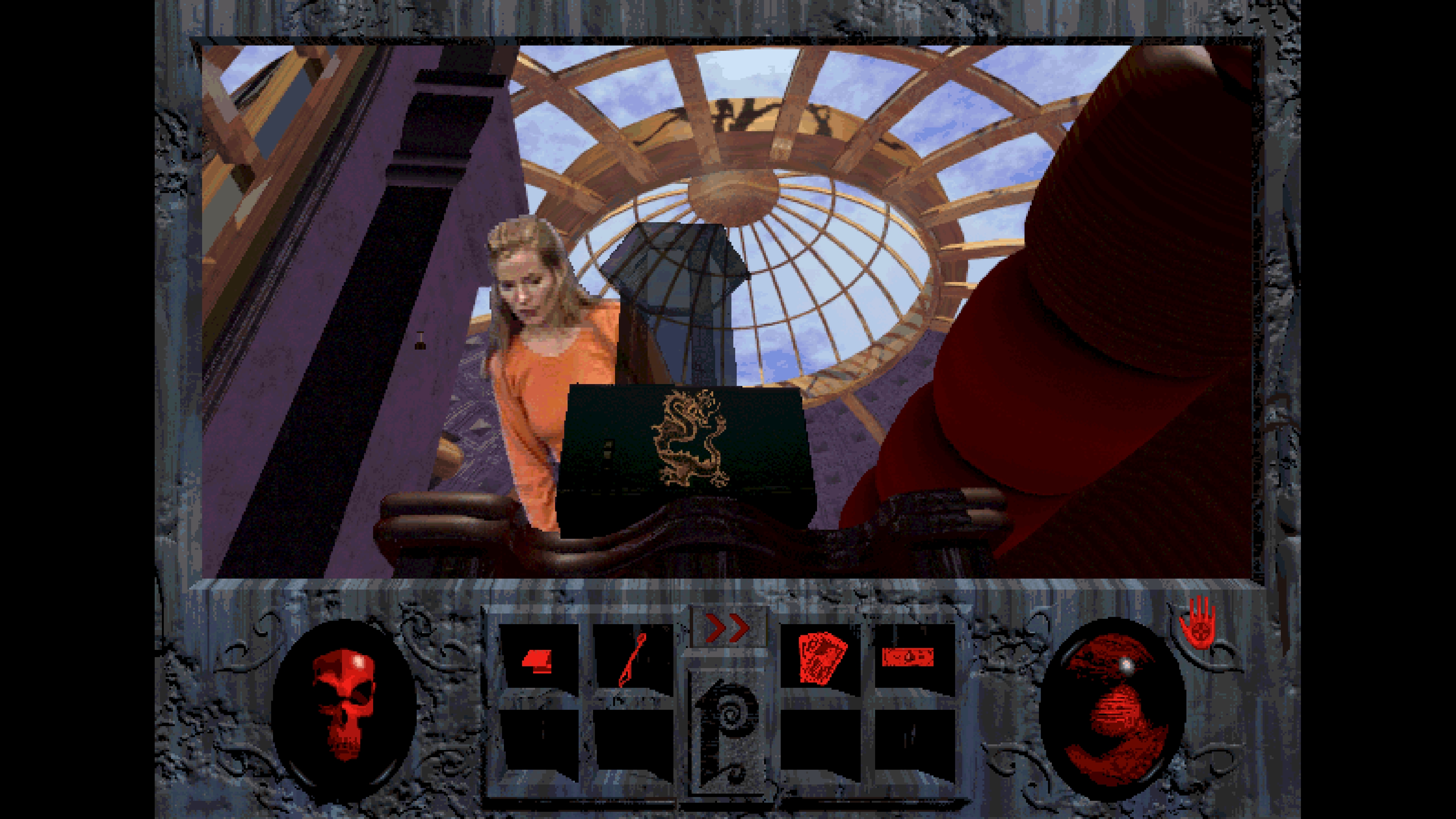
TOTALLY CONVINCING.
The largest multimedia product released to date, huh? Hmm. Note also that the article takes care to comment on the game's difficulty, which was, as noted here, a big source of controversy in the day.
In the First Degree is profiled at length elsewhere in the issue in an article on interactive movies. It seems quite interesting and professionally-made; I'd like to give it a shot, if it didn't mean wrestling with DOSBox.
The Journeyman Project series was very much of its time, the early CD era; it's largely forgotten today. I got the first game with the first computer I got with CD-ROM, with one of those packs of largely-useless CD titles (home landscaping planner, almanac, licensed kids'-cartoon maker - mine was Spider-Man) that frequently came with CD-ROM computers at their advent. You were a timecop tasked with stopping a mad scientist making moves against the U.N. by dispatching hulking robots to commit time crimes. As I recall, the gameplay consisted of walking through then-cutting-edge CG environments interspersed with very light adventure-game mechanics, with completely-unrelated minigames popping up when it came time to confront the robots. The minigame I best remember depended on knowing world geography to deactivate a bunch of missile silos by moving a cursor around a globe with the mouse sensitivity jacked way up to each target. I am not sure, but I believe this was the first time I ever encountered the concept of "Reykjavik." The robot for this level would be watching and taunting you on a nearby monitor in the meanwhile; when thwarted, he would intone "the only good human is a dead human" and leave to stride down the halls toward you in frame-by-frame first-person to kill your ass, which I recall actually finding a bit scary. The game offered a "Ghandi bonus" (misspelled) for using allegedly less-violent means of dealing with the antagonists, and I don't recall whether crushing the robot by increasing the pressure in his room or crushing the robot with the giant mechanical arm in the nearby submarine dock was considered less violent, but the answer is clearly "neither."
That's The Journeyman Project!
Also, Johnny Mnemonic and his 80-GB brain. She's got STEEL on her BOOTS! Ahhh. Remember being able to reference Giant Bomb unencumbered by all the complicated feelings its backstabby implosion inspired? Good times.
I have to wonder how bad the acting in Under the Killing Moon was for FMV-loving GAMES, at the height of the FMV era, to deem it "unacceptably awful."
A lot worth mentioning on this page. The short reviews are also markedly more complete in the 1995 issue than they are later on.
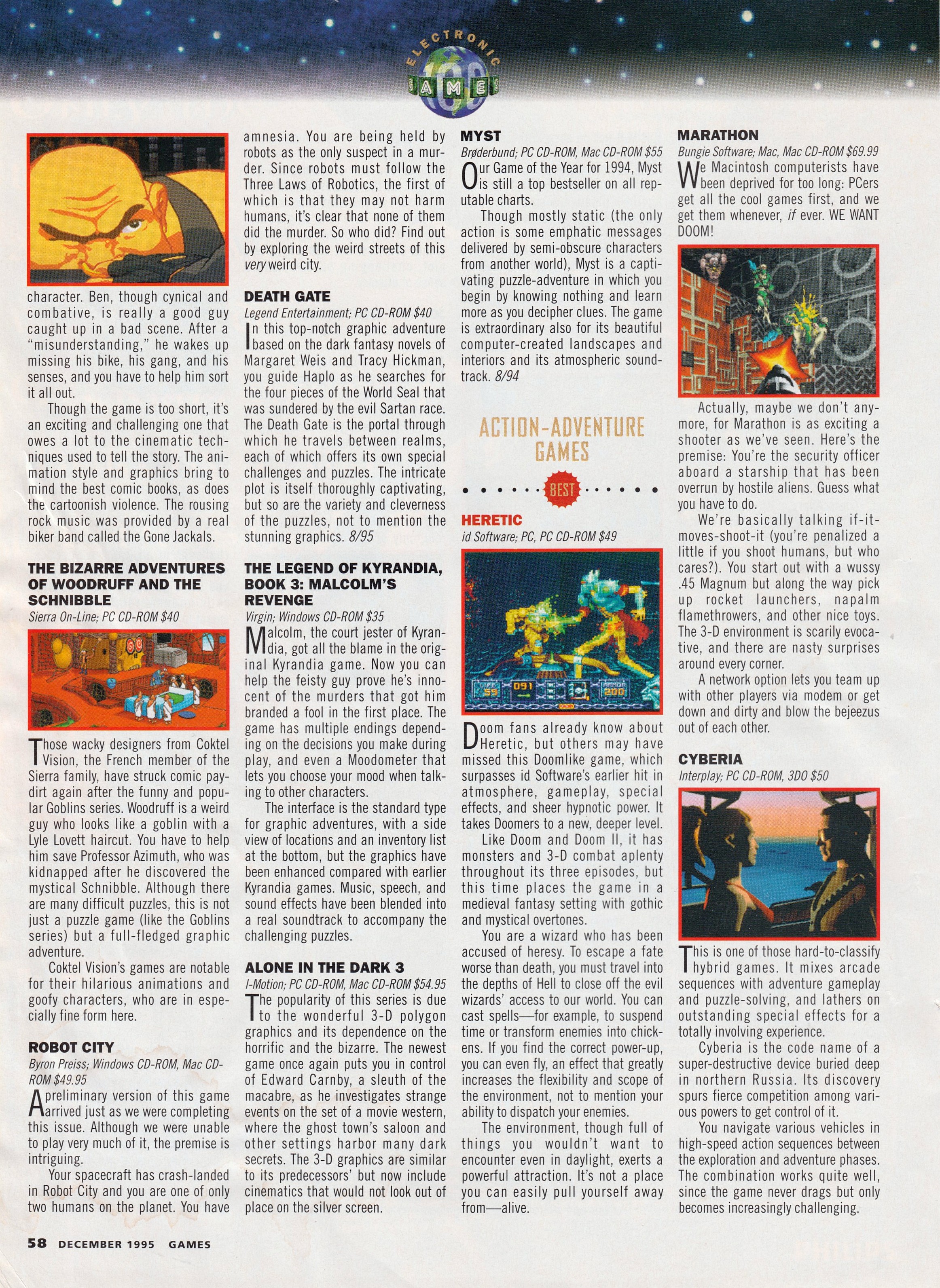
More "of its era" choices on these pages. I remember Game Players featuring questions for Alone in the Dark 3 in its hint pages, including a "most frequently-asked" feature, so it must have had a good deal of popularity in its day; the original has claims to being one of the first survival horror games, and the series was pioneering in its use of cinematic camera angles. From my recollections of playing with the original and video evidence, though, the series is just unworkably slow, both for modern tastes re: pacing and for the combat it's attempting. (And I'm, uh, not sure those cinematics would hold up to a silver-screen treatment today, though the impression the use of cinematographic techniques, camera angles, editing etc. left on the GAMES crew speaks to how novel the language of film was in games in the early CD era.)
In further "early CD era" and Game Informer Replay fodder, we have Cyberia, one of those titles with minimal light adventure gaming mechanics mixed with QTEs that was basically a clothesline for plasticky prerendered FMV cutscenes. It's a form of game that's seen absolutely no revival in the modern age, for good reason.
"Doomers." I like how the reviewer dispenses with Marathon's plot: "You're the security officer aboard a starship that has been overrun by hostile aliens. Guess what you have to do."
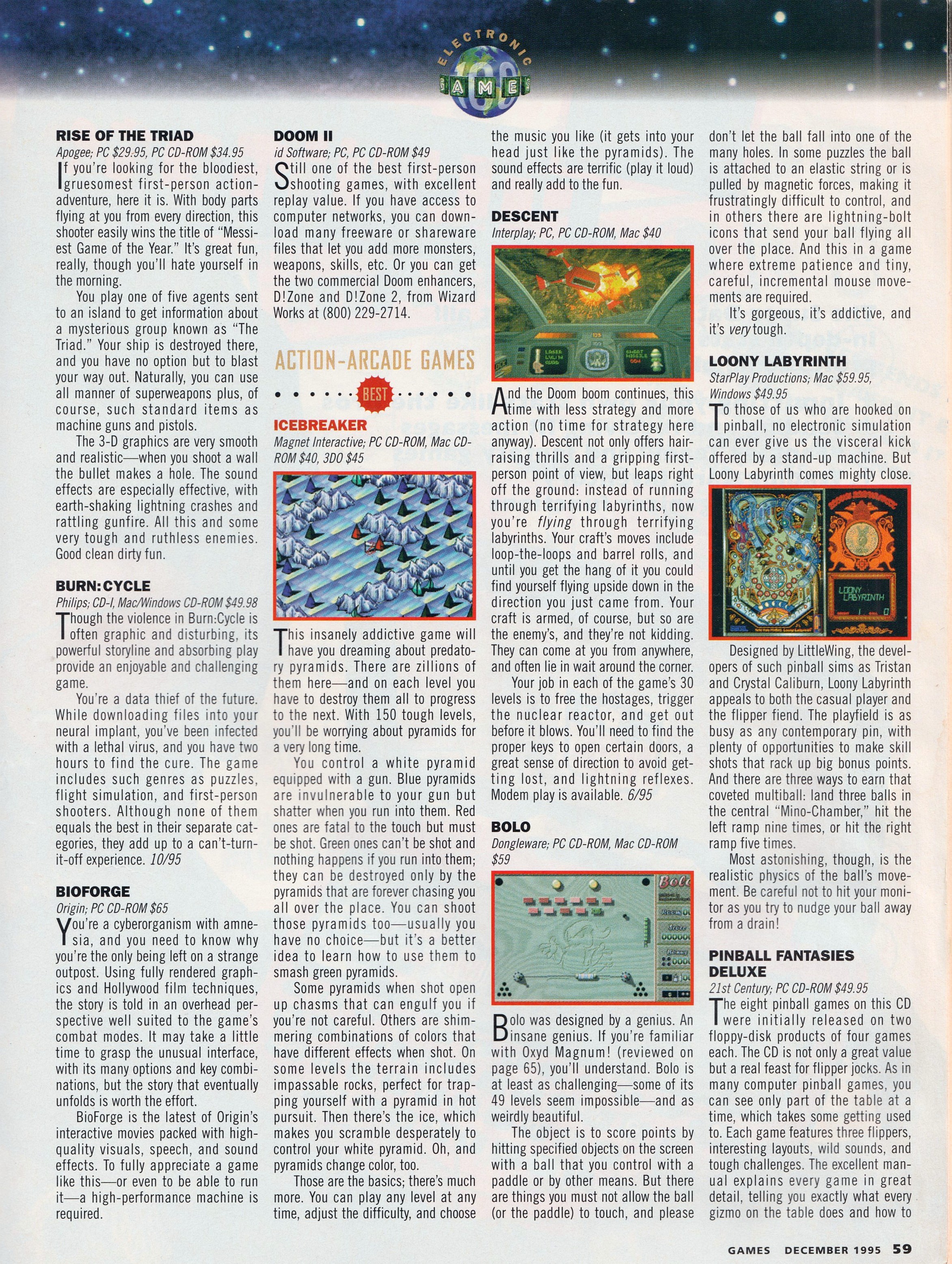
Though it's FMV, I feel like Burn:Cycle can be put on the Cyberia pile. Is there a reason to put these in Action-Adventure and Johnny Mnemonic in Adventure? They're all the same thing, right?
Meanwhile, GAMES dips its toe into Doom WADs.
Bolo makes what evidently is its first appearance, preceding its '96 award. I know standards were different back in the day, but I cannot see labeling that inverse-watermark woodgrain as a "gorgeous" graphic. The winner of this category, Icebreaker, seems also to be glorified shareware.
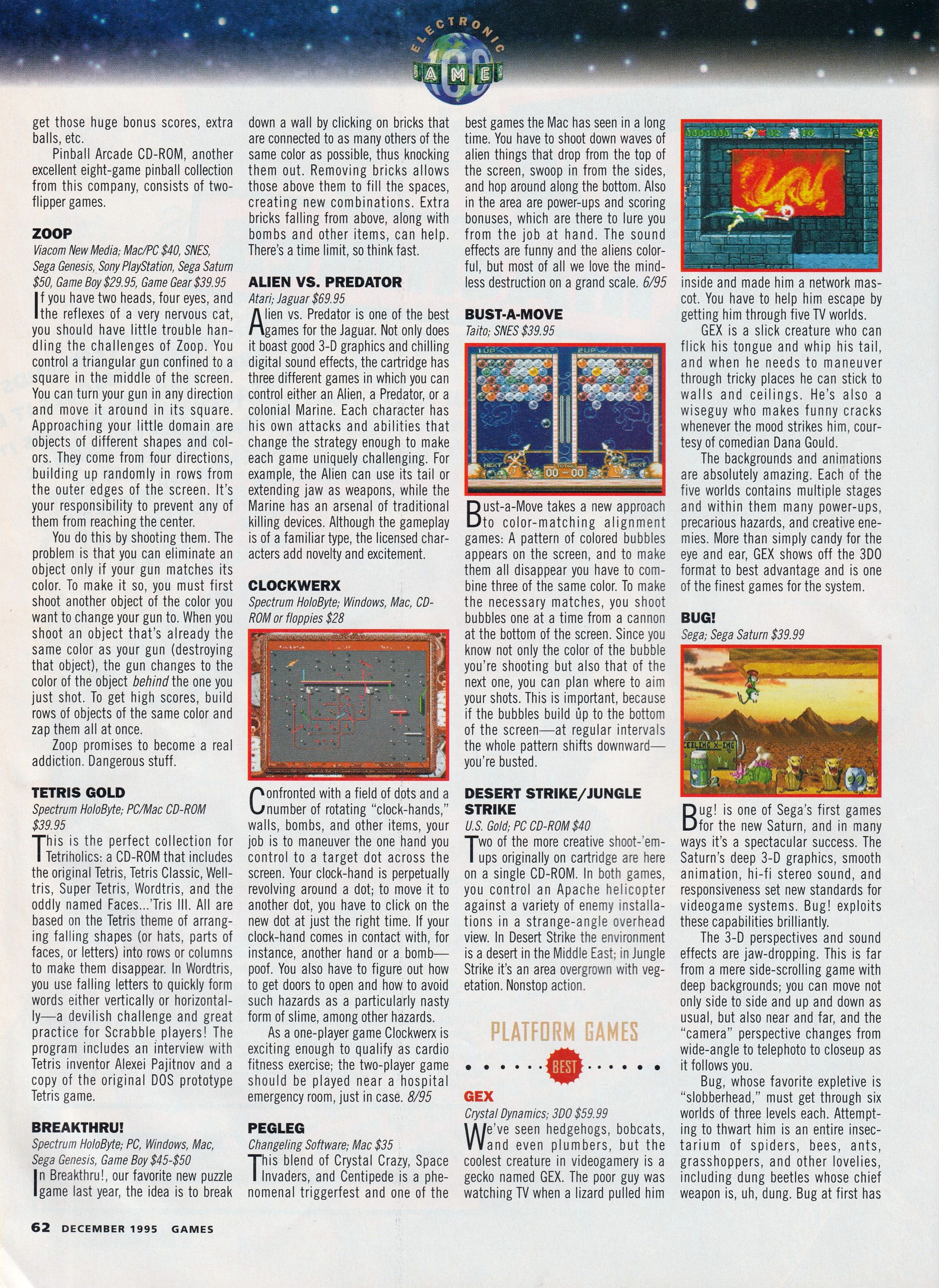
The "Action-Adventure" category is almost entirely puzzle games, with a couple vehicle shooters (shouldn't they be in Simulation, by GAMES rules?) and Alien vs. Predator. GAMES is, however, one of the few stateside publications to give Bust-a-Move recognition in its day.
Big times for Alexey Pajitnov fans, with Tetris Gold and Breakthru! (which was advertised as "presented" by Pajitnov in the last GAMES 100) honored. "The original DOS prototype of Tetris" - I don't think I've ever played that.
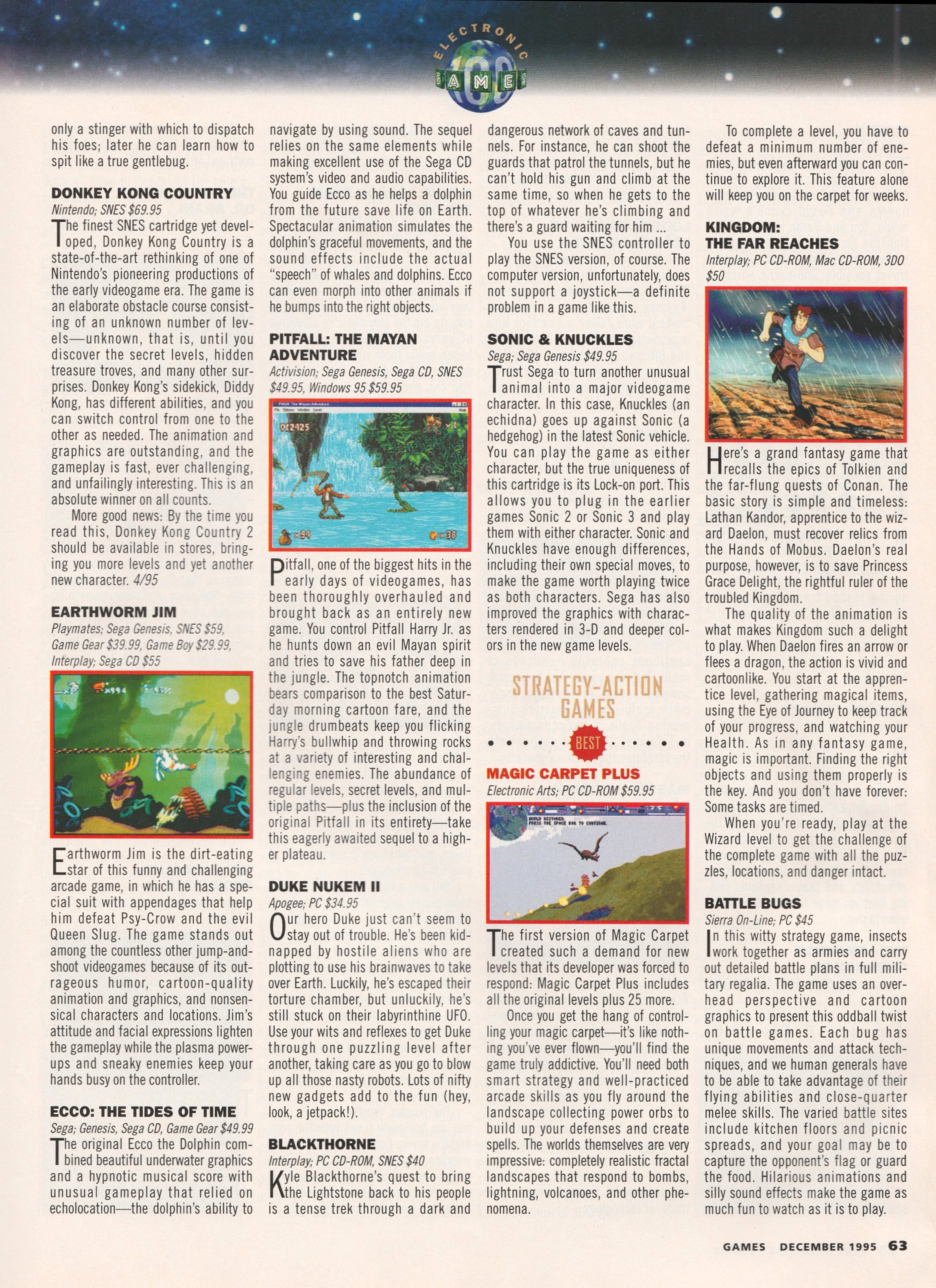
See the '96 entry for appropriate commentary on the inclusion of Gex and Bug!. Also: by GAMES rules, shouldn't Desert Strike and Jungle Strike be Simulation games, since you're piloting a military vehicle?
More old drums being beaten here. Again, GAMES is greatly impressed by graphics that aren't merely good but visually-distinctive in some way: Donkey Kong Country CG, Earthworm Jim's hand-drawn animation, Blackthorne's lavish sprite animations, Ecco's environmentally-themed world (that was big in the '90s and would have been a sufficient marker of maturity for GAMES at the time). Again, GAMES is disproportionately impressed by older names and franchises in gaming, as with honoring Pitfall: The Mayan Adventure. (This game's star has fallen considerably since its day, but it never took off in the general market in the first place. Would that make it a brown dwarf, then?) Again, we have names that were big at the time but seem dated now, such as Duke Nukem.
Looking at Kingdom, it seems like the sort of production that should've been big and landmark in a Dragon's Lair-type way, but it really fell off the face of the earth.
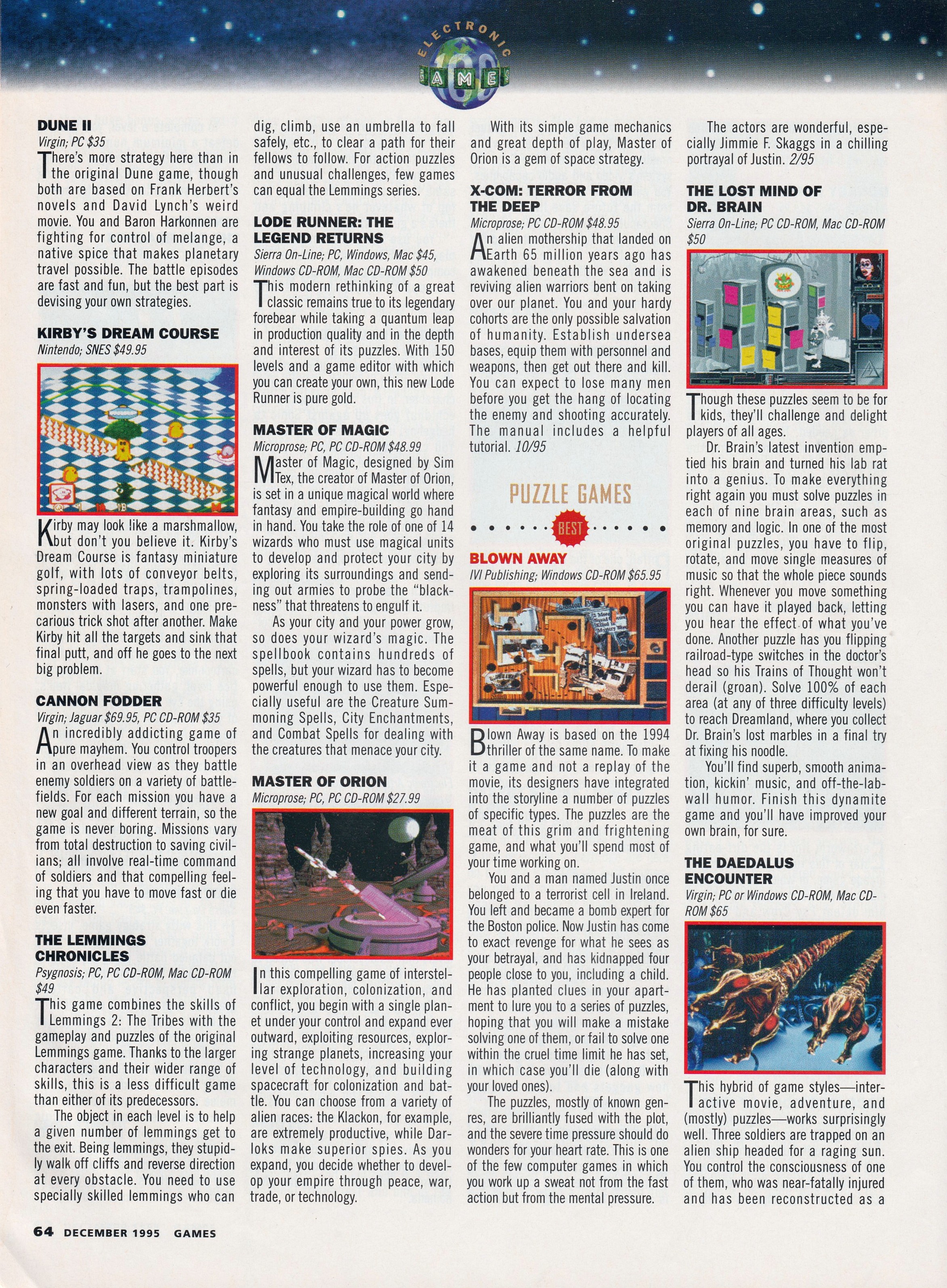
GAMES's definition of "Strategy Action" continues to be a quandary (or, rather, still was in '95, before '96). There's plenty here that fits my approximate guess of "games that have strategic and puzzle elements and focus on organizing & directing resources but also include some elements of timing," but there are more outliers, more disparate than before: the FMV adventure Kingdom, the overhead shooter Cannon Fodder, the 3D flying sim/shmup Magic Carpet - a Lode Runner game. I'm hard-pressed to find a point of commonality between these titles. Maps?
Equally oddly, mini golf, here represented by Kirby's Dream Course, is an enduring pillar of this "genre."
There was a Blown Away game. Blown Away is, weirdly, heavily identified with FF6 for me, as I rented it from the video store the same night my family rented this. I played through the final battle to the end of the game on someone's finished save file. (I did this with Phantasy Star IV as well.) I remember watching the ending and having no blessed idea who Setzer was. For some reason, doing this never spoiled me, as I didn't have the context to understand the full significance of events, and I didn't remember what happened by the time I played through the games myself. (Also, the person who played through FF6 on that file missed a lot of the characters, so the ending had lots of gaps.) I don't know really why I did it in the first place. The novelty and lure of unearned endgame content, I guess.
What were we talking about? Oh, yeah; Blown Away. I haven't played the game version. I have to wonder how that acclaimed performance of the villain plays nowadays.
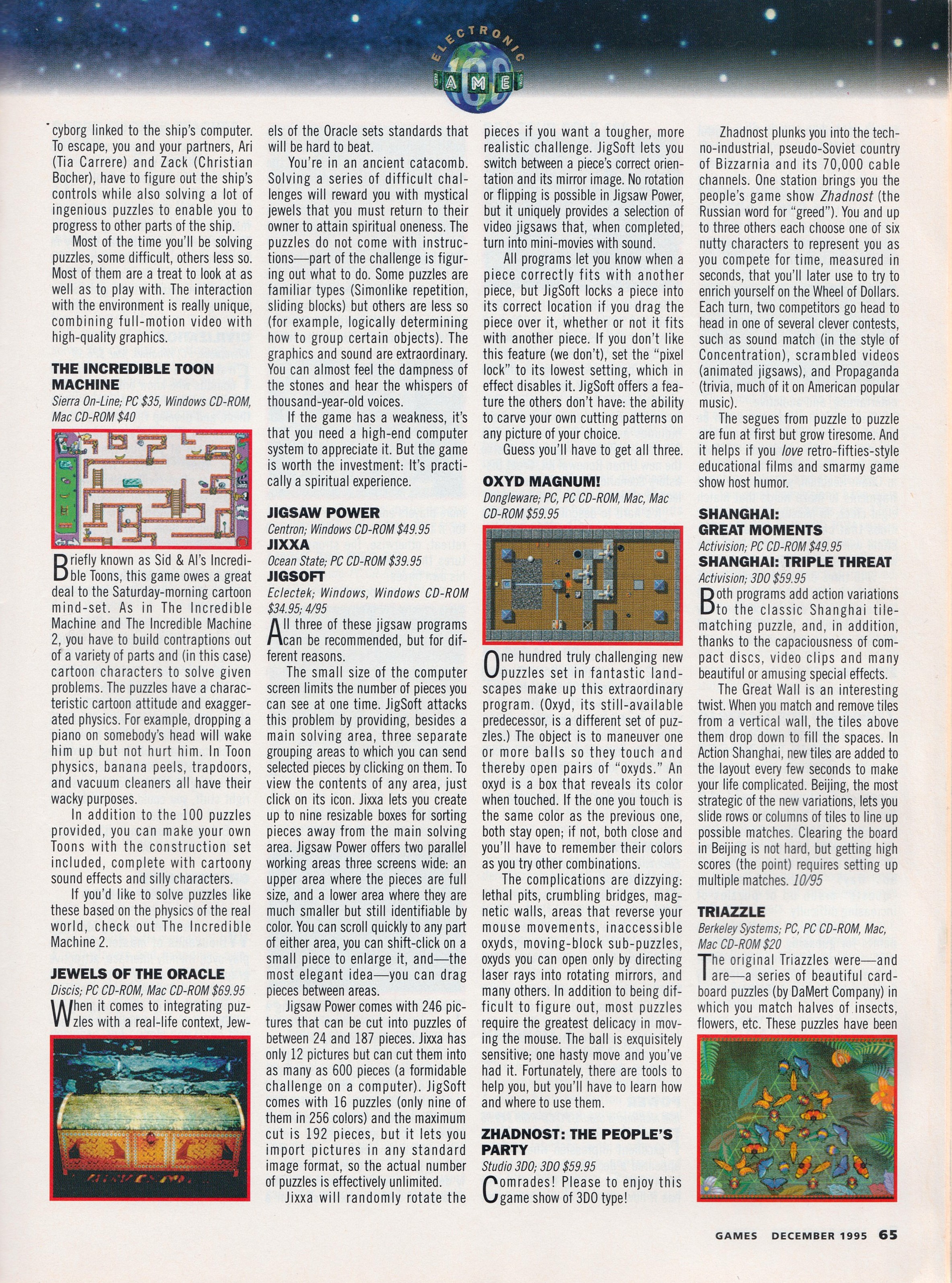
More (actual) puzzle titles. Not much to note here beyond the huge price tags on shareware and how '90s screen resolutions proved a big stumbling block for jigsaw titles. GAMES appreciated the 3DO more than any other publication.
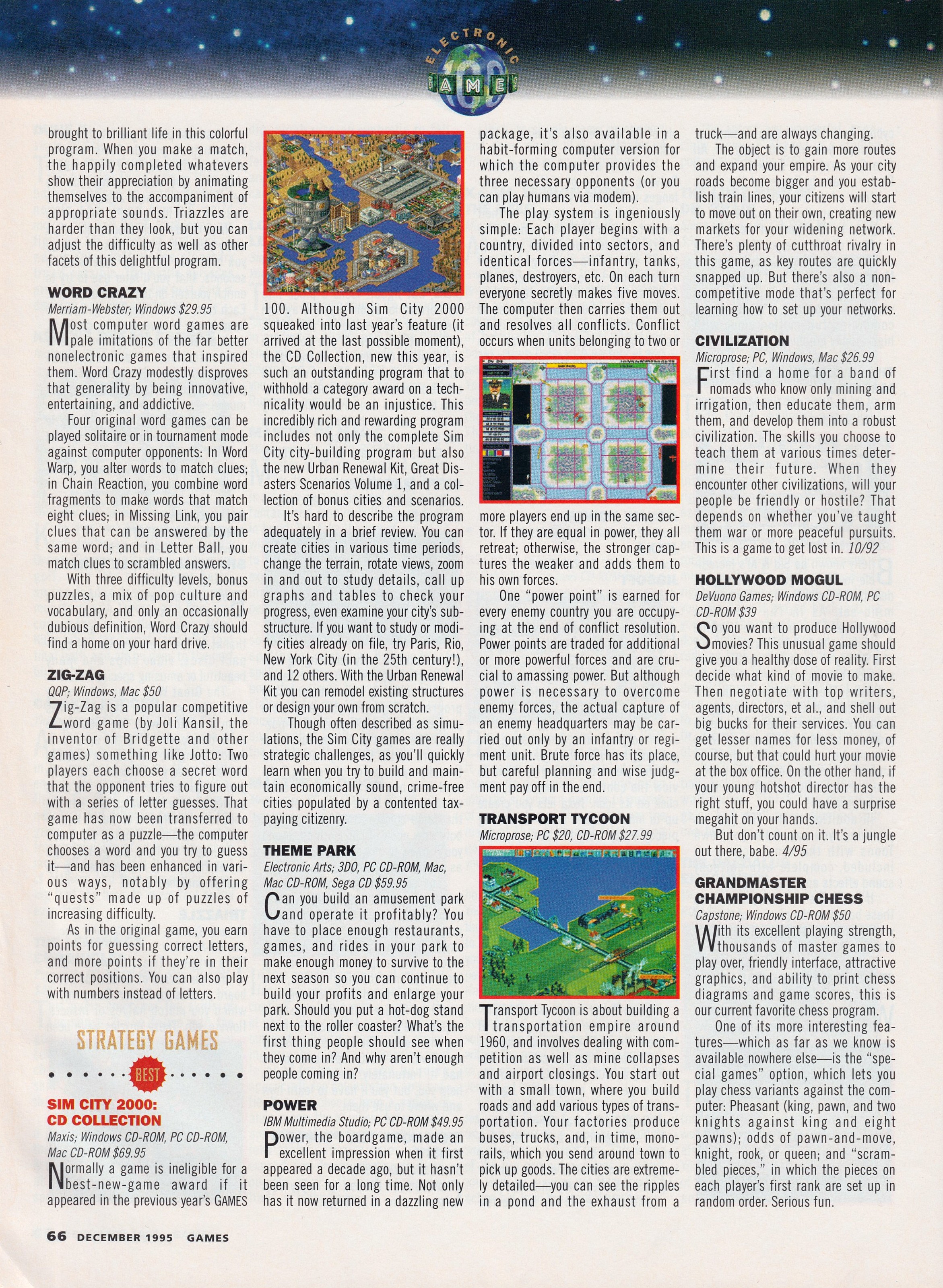
Strategy. Again, GAMES's definition of the genre proves disappointingly logical. (Also, Civilization: "a game to get lost in," indeed.)

Look at the entry for Tony La Russa Baseball 3. There was a software manufacturer named...well, I'm not going to mess up my search results.
(As I mentioned, most of this article was written in 2023, but 2026 me would like to pop in with a reflection on the curiosity of Baseball for Windows with Ernie Harwell Broadcast Blast: as per this video, it seems to generate radio broadcasts of simulated games from canned lines, played over a static jpeg of a baseball diamond (with little text name tags popping up as runners round the bases).)

GAMES just misses the boat and honors NHL '95 but not '94. They get on the Earthbound boat way early, though - before that sucker even launched. Earthbound was not well-reviewed in its day - the decision to go for a distinctive graphical style instead of just the "best" sprites pixel artists could muster at the time was unheard-of and just written off as a case of flatly bad graphics. I'm not fond of Earthbound personally, but I do have to say that for all the times GAMES's odd priorities failed them, they proved genuinely forward-looking here. (They even spelled "Giygas" correctly.)
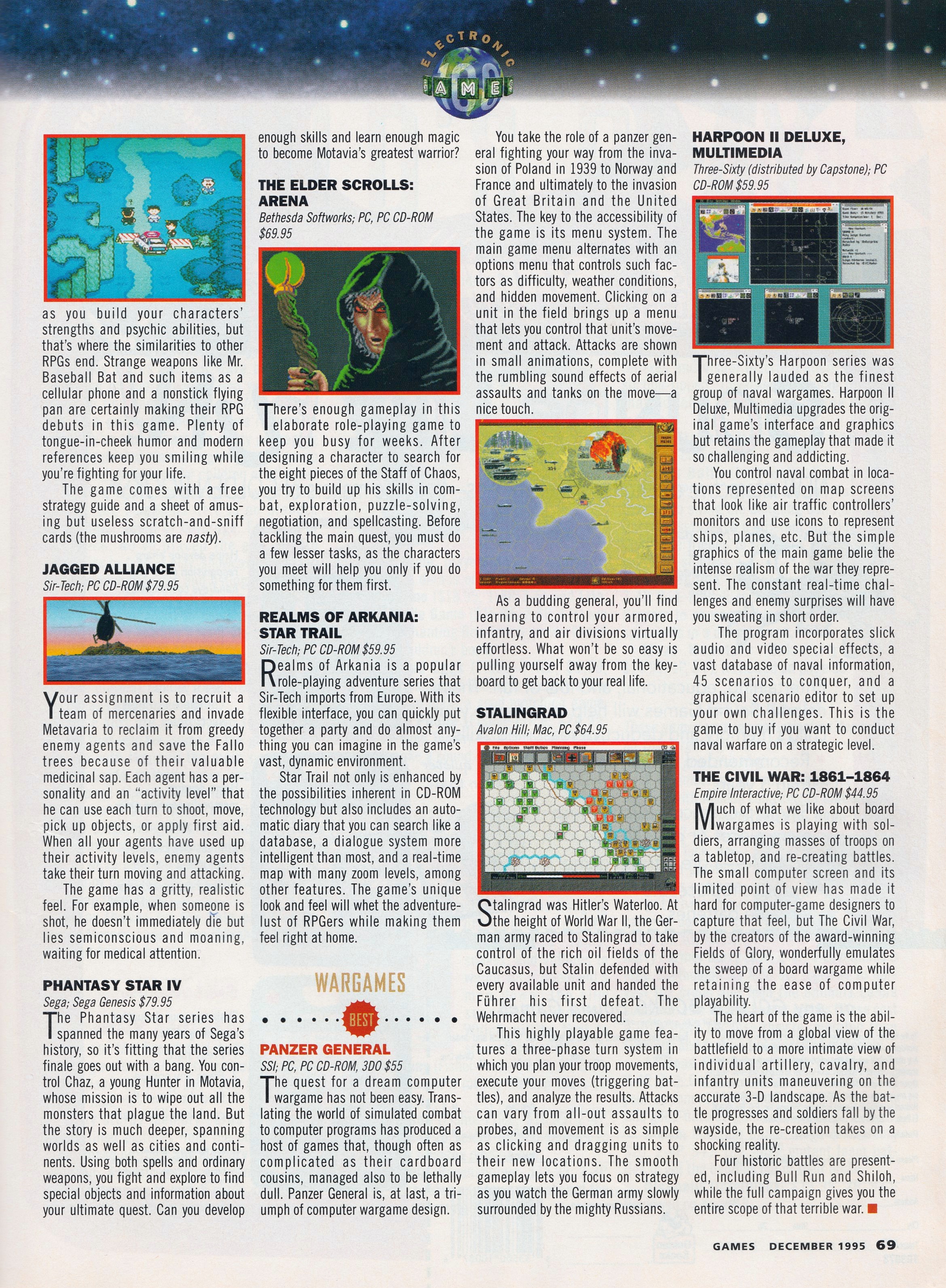
Also with Phantasy Star IV. I have, truth be told, accumulated a bit of unfair resentment toward PS4 over the years due to its popular usage in the gaming press as sort of (to pull an analogy from movie reviewer Arbogast on Film) a Restoration Hardware - a source of manufactured, prepackaged cred. It's used as cheap shorthand to indicate that the writer has a working knowledge of 16-bit deep cuts - never mind that the Phantasy Star franchise was the primary competition for Final Fantasy in the U.S. market in its day, or that the game is short & easy and requires practically no effort to "discover." Praise for PS4 is near-always coupled with contemptuous dismissal of the other games, which the writer typically has never touched and finds beneath their notice, as love for them signals nothing useful to their audience.
Anyhow, my point here: PS4, despite getting attention nowadays for the wrong reasons, was, despite its shortcomings, a genuinely sleek, sharp, fast, forward-looking RPG - but if contemporary publications acknowledged RPGs at all - which, remember, were considered firmly niche in the U.S. until FF7 and, to a lesser extent, FF6 and Chrono Trigger - it would typically be Square's output, so GAMES giving the laurels to PS4 and Earthbound is genuinely praiseworthy.
But, uh, nowhere to be found: Chrono Trigger. No, it doesn't appear next year, either. (Also never honored: the aforementioned FF6.)
A couple more notes. First, in the entry on The Elder Scrolls (which also appeared in the '94 GAMES 100), it's interesting that the very concept of fetch quests is, at least to GAMES, still novel enough where the idea merits description. Second: I was going to ask how that Jagged Alliance game qualified as an RPG, but I'm distracted by its premise: to save the "medicinal sap" coming from the "Fallo" trees. Uh-huh.
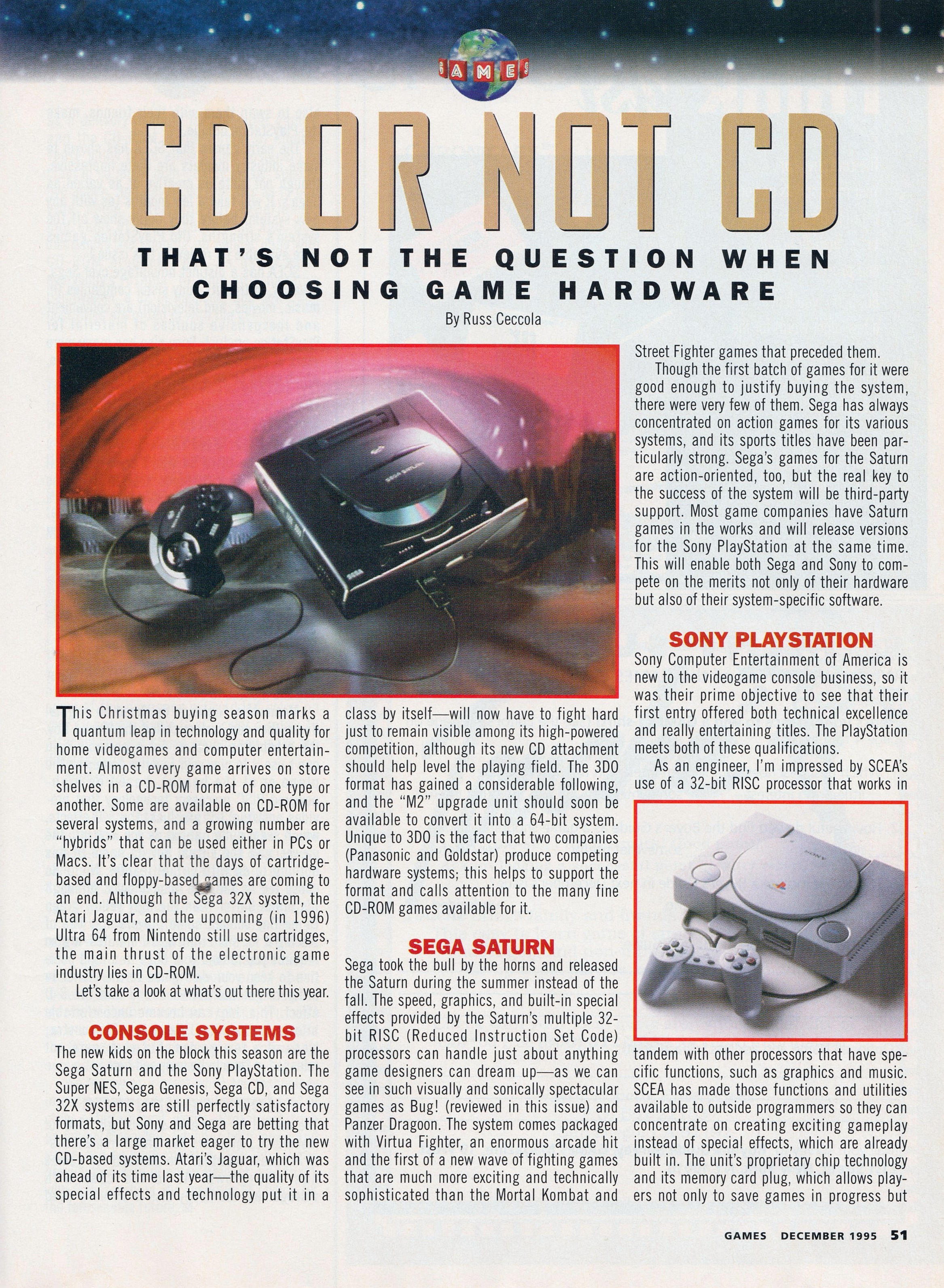

The expansion and split of the GAMES 100 into boardgame and electronic editions was accompanied by a few additional features. I don't think the GAMES 100 was this lavish before or since - save, perhaps, for the unseen-by-me '94 standalone edition, sold separately on newsstands.
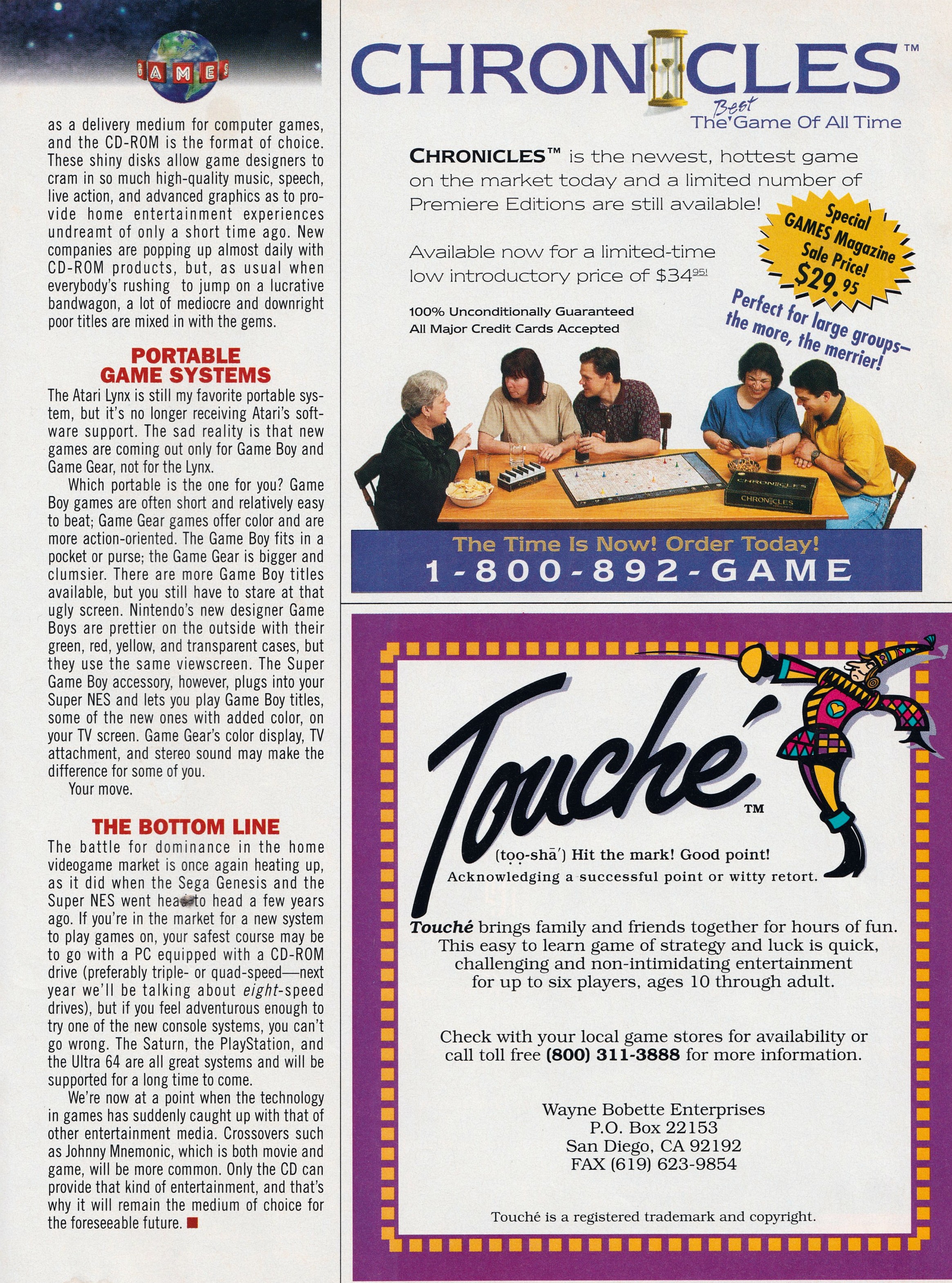
First, as this was the dawn of the CD era and the 32-bit consoles, GAMES had an engineer write an article to sort through the various new systems, CD-based and otherwise. Amazing that someone writing for GAMES knew enough about gaming to be familiar with the M2. On other hand, we have the claim that the "special effects" in PS1 games are "built in", so the programmers don't have to worry about creating them (????????????). The entire article is one big "of note" expanse, but a few selected highlights:
- GAMES's undying love of Bug knowing no bounds
- the author identifying the Virtual Boy as unsustainable even before launch
- the marvel at Apple's market share actually growing ("The market for PCs and, surprisingly, Macintosh computers has grown tremendously in recent months")
- the author being realistic about his stalwart support for the Lynx but wearing his affection proudly on his sleeve
Also, please enjoy the vintage ads on the sides.
